17. ROS1_ROS Robot with Robot Arm
17.1 Robotic Arm Installation and Wiring
The installation tutorial video for the Puppypi robotic arm can be referred to in the same directory under Robotic Arm Installation. Below is a schematic diagram for the installation of the Puppypi robotic arm:
Use four M46 round head machine screw to secure the robotic arm to the Puppypi. Due to the replacement of old and new versions of Puppypi sheet metal parts, some sheet metal parts can only be installed with two M46 round head machine screws. Please refer to the actual Puppypi sheet metal parts for specifics.
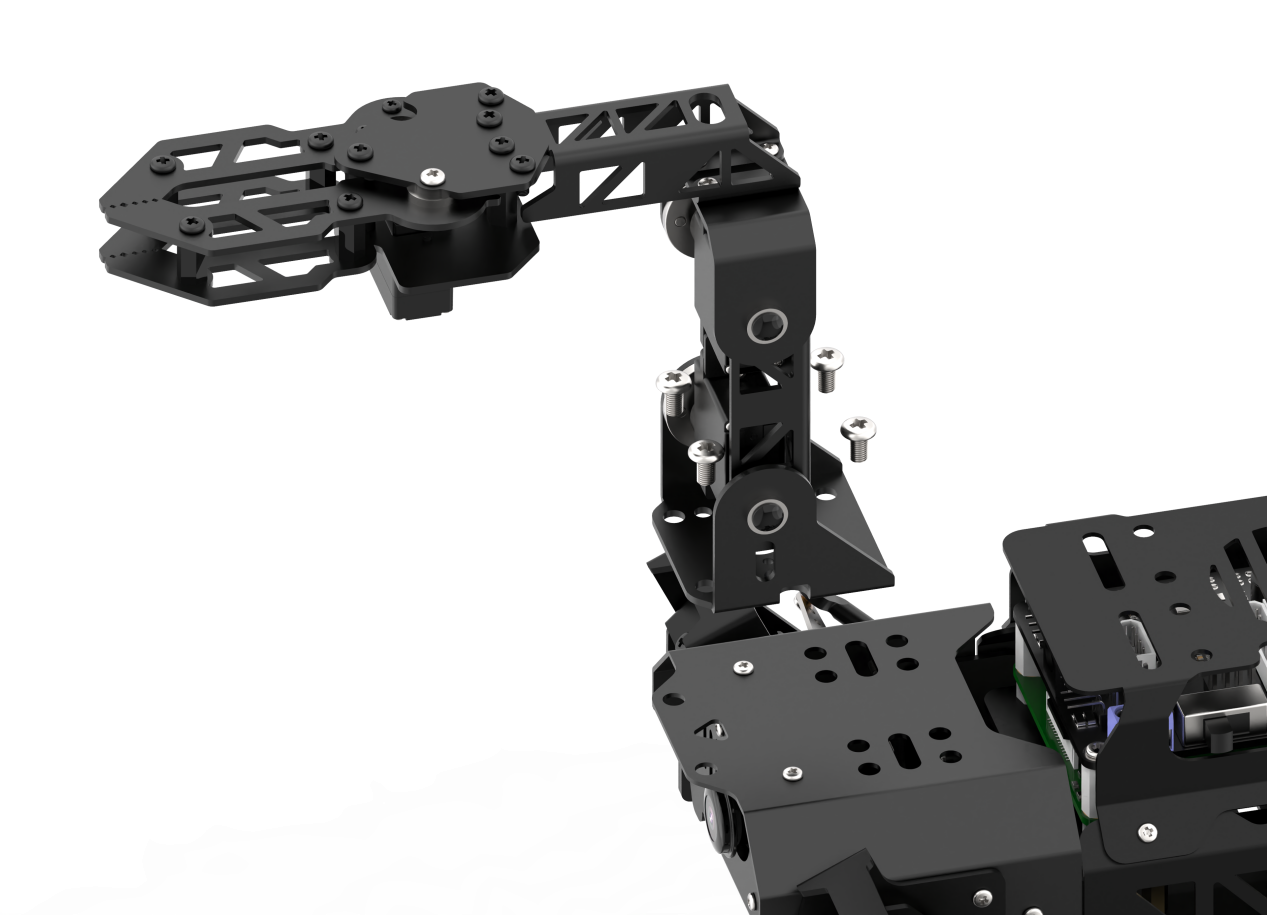
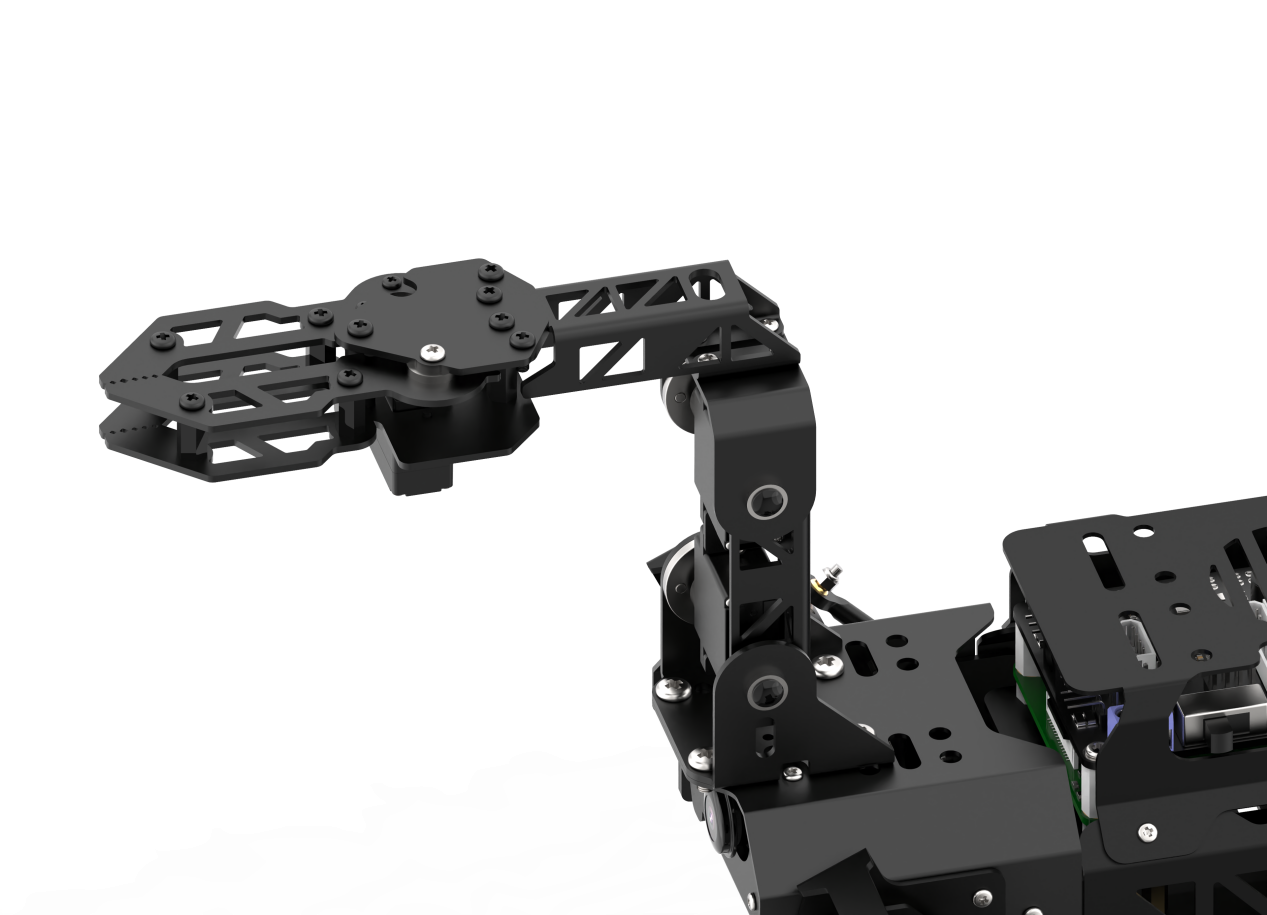
M4*6 round head screw
Connect the servos ID9, ID10, and ID11 on the robotic arm to the PWM servo interfaces 9, 10, and 11 on the Raspberry Pi expansion board as pictured:

17.2 Power-on Inspection
17.2.1 Robot Power-on
Note
Do not start PuppyPi on rough or uneven surfaces.
Do not forcibly move the servos after powering on to avoid damaging them.
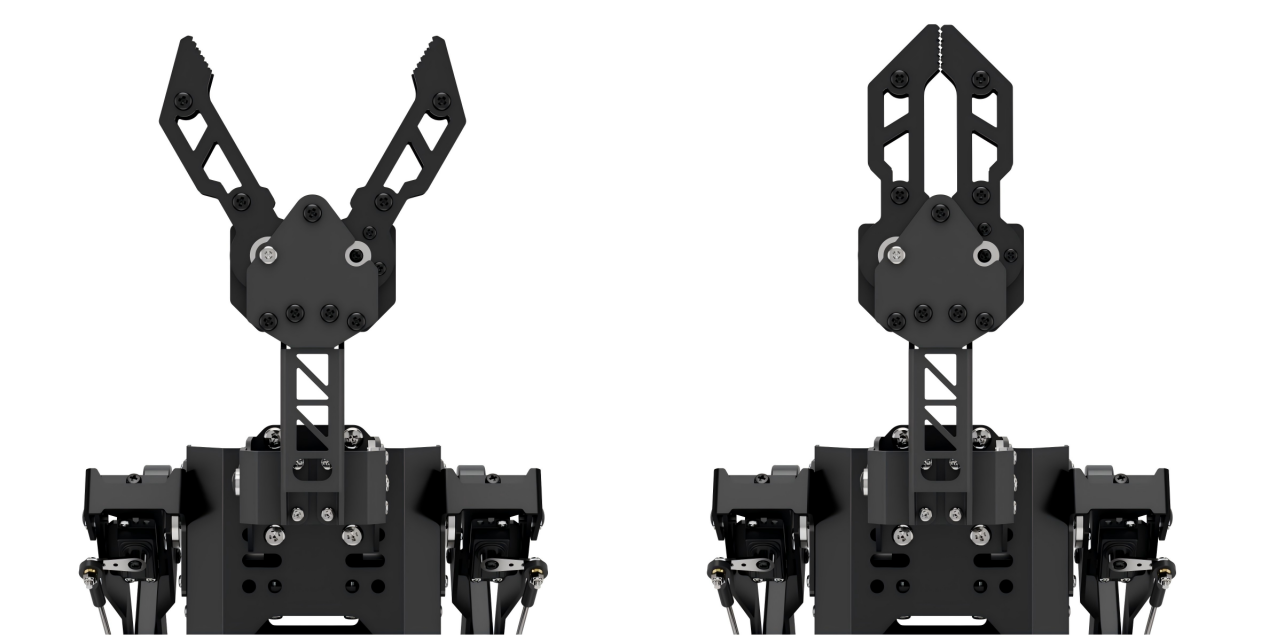
(1) Before powering on, to avoid servo damage from sudden movement, place PuppyPi in a lying position on a flat surface. The robotic arm should be positioned facing forward, as shown in the diagram below:
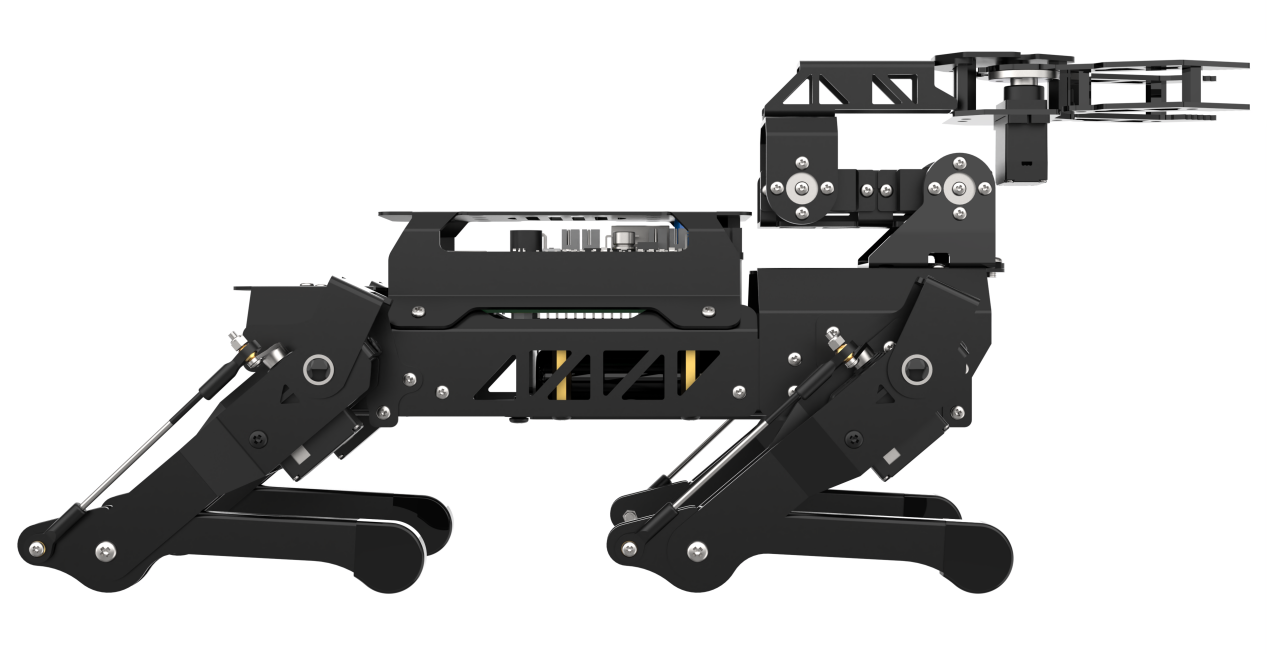
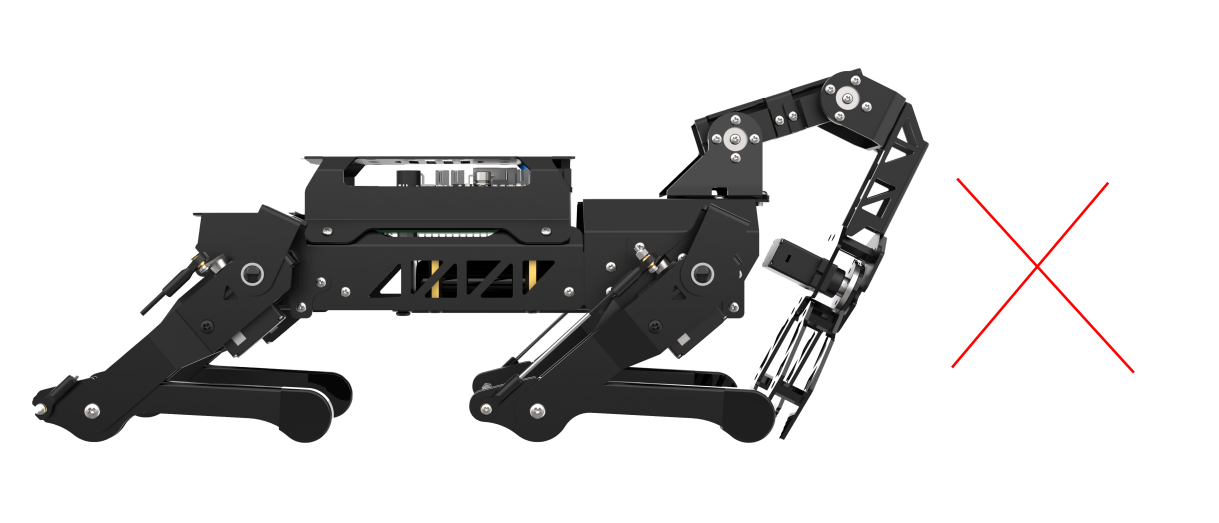
Note
Before powering on, the robotic arm must be positioned facing straight forward. Do not position it hanging downwards to prevent damage to the robotic arm when the servos are powered on.

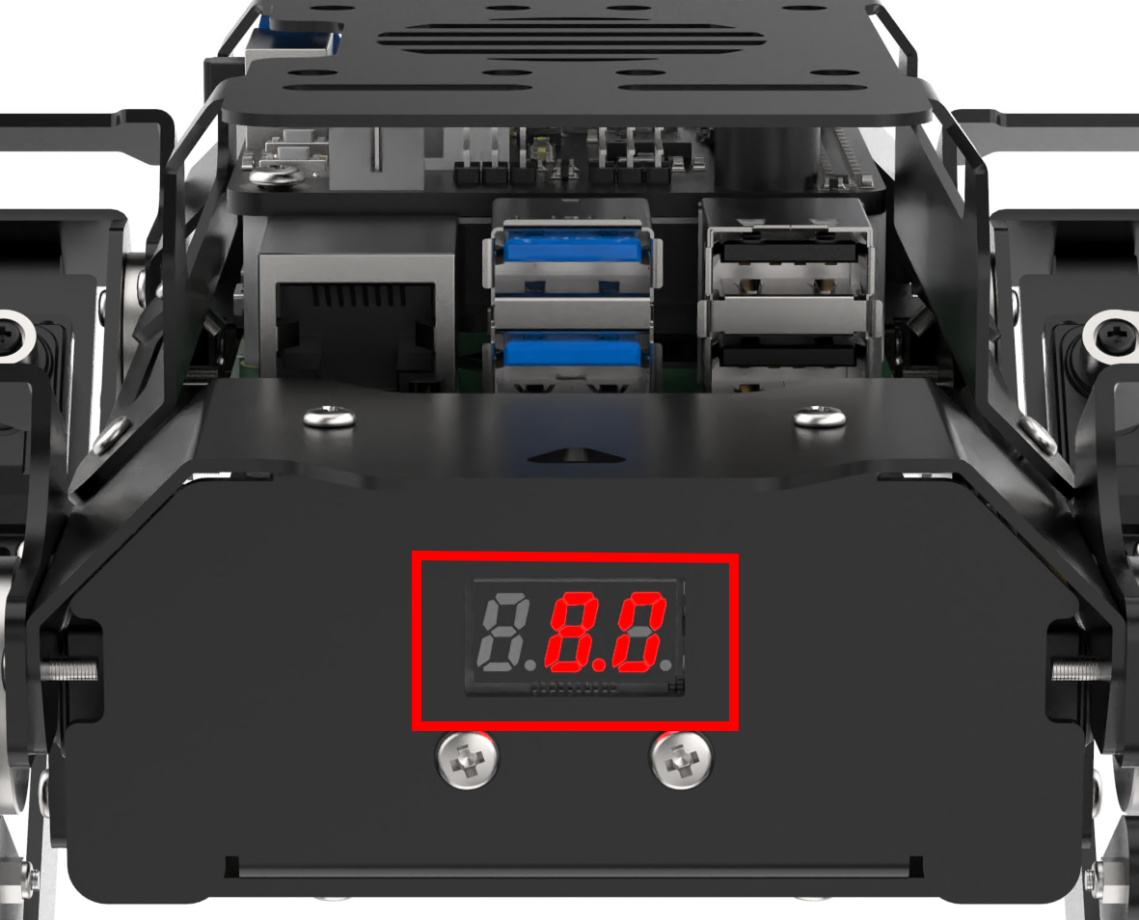
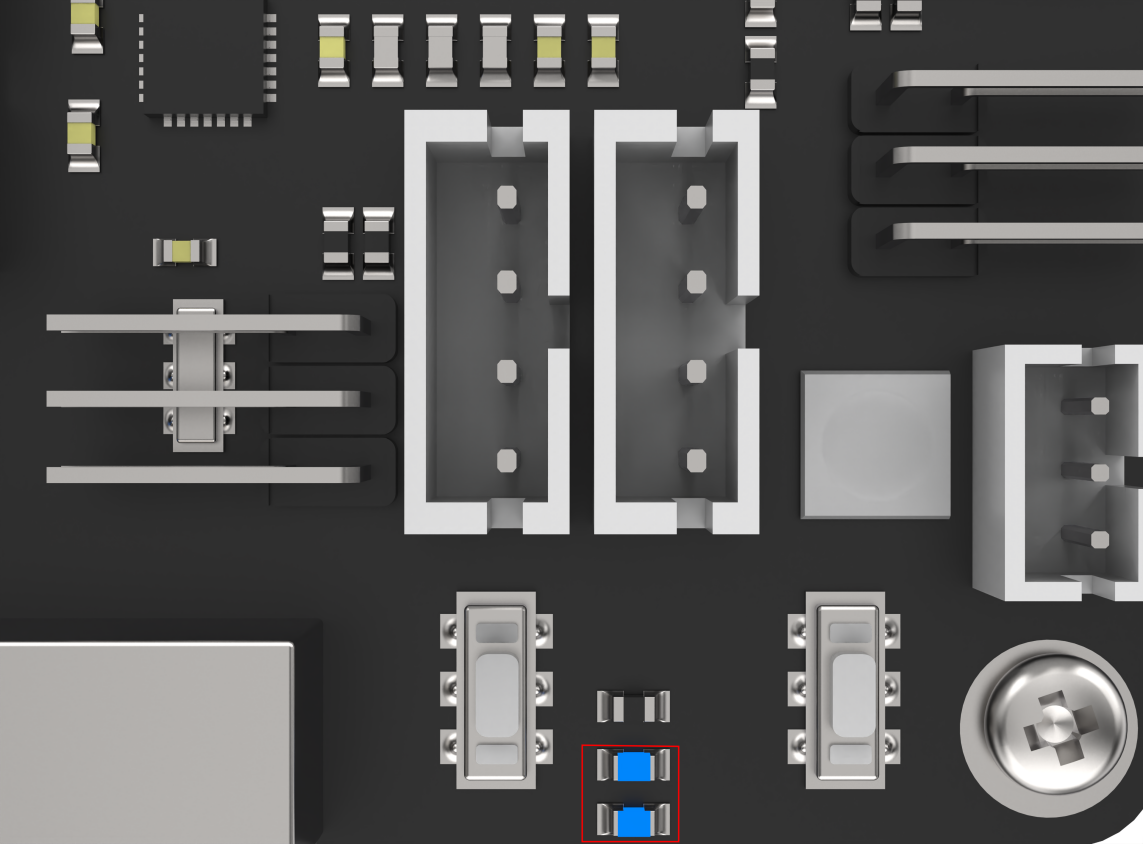
(2) Then, push the switch on the expansion board from OFF to ON. After powering on, the digital display at the tail of the robot dog will show the current battery level (it lights up at 8V as pictured). when the battery level is below 6.8V, the battery needs to be charged as soon as possible. LED1 and LED2 will emit a faint blue light. After a short wait, LED1 will stay on continuously, and LED2 will blink every two seconds, indicating that the network configuration is ready. Finally, wait for a beep from the buzzer, indicating that the ROS configuration is complete and the device has successfully started.
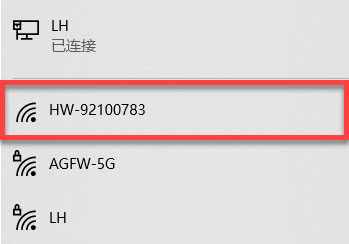
(3) The device defaults to AP direct connection mode out of the factory. After successful boot-up, it will generate a hotspot starting with HW.
17.2.2 Inspection
(1) Click the icon in the top-left corner  of the desktop to open the system terminal.
(2) Enter the following command to navigate to the puppypi directory:
cd puppypi/
(3) Run the following command to execute the robotic arm test script:
./arm_test.sh
During the test, the robotic arm gripper will first open and close, then perform a complete grasping motion. Once the sequence is complete, servos 9 and 10, as well as servos 10 and 11, should form a 90-degree angle with the tabletop or other flat surface, as illustrated below:
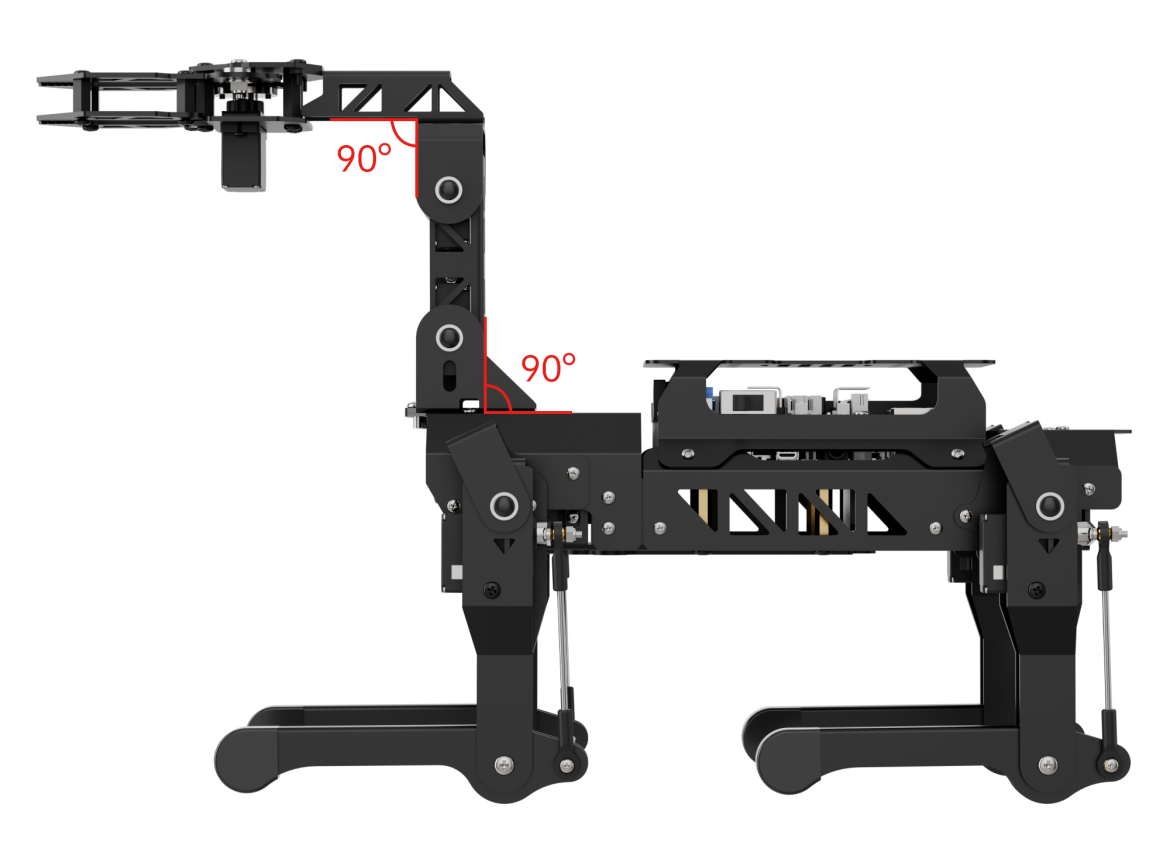
If there is any noticeable deviation after the test, please proceed to the next section, “17.3 Robotic Arm Deviation Adjustment”, for calibration instructions.
17.3 Robotic Arm Deviation Adjustment
17.3.1 Determine Whether Offset Adjustment is Required
Offset adjustment is not necessary if the PuppyPi robotic arm meets the following initial posture conditions after powering on:
(1) The arm remains vertically aligned with the main body
(2) The two connecting rods form a 90-degree right angle
(3) The gripper is properly closed
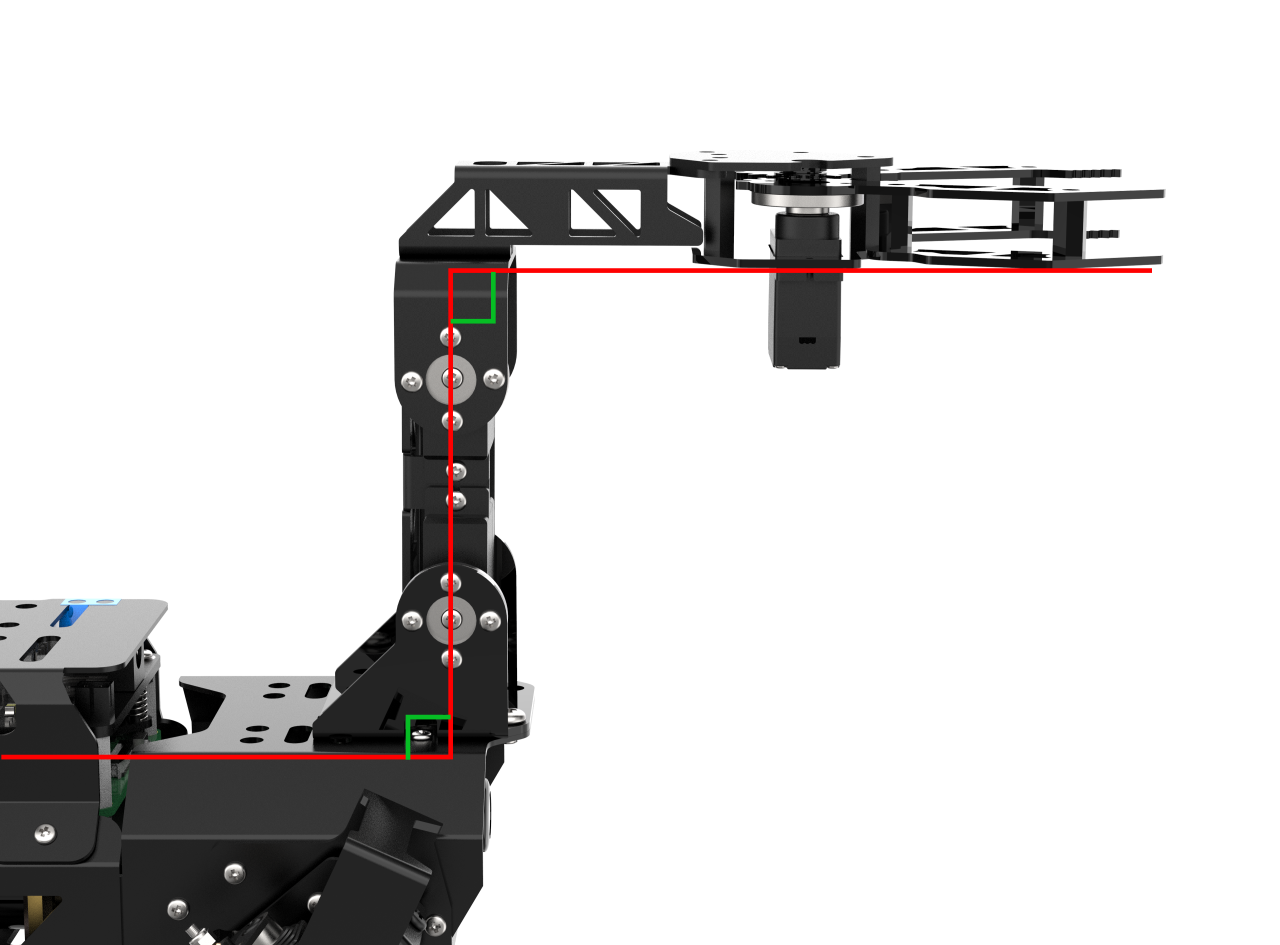
If the robotic arm appears misaligned, as shown in the reference image, offset calibration is required.
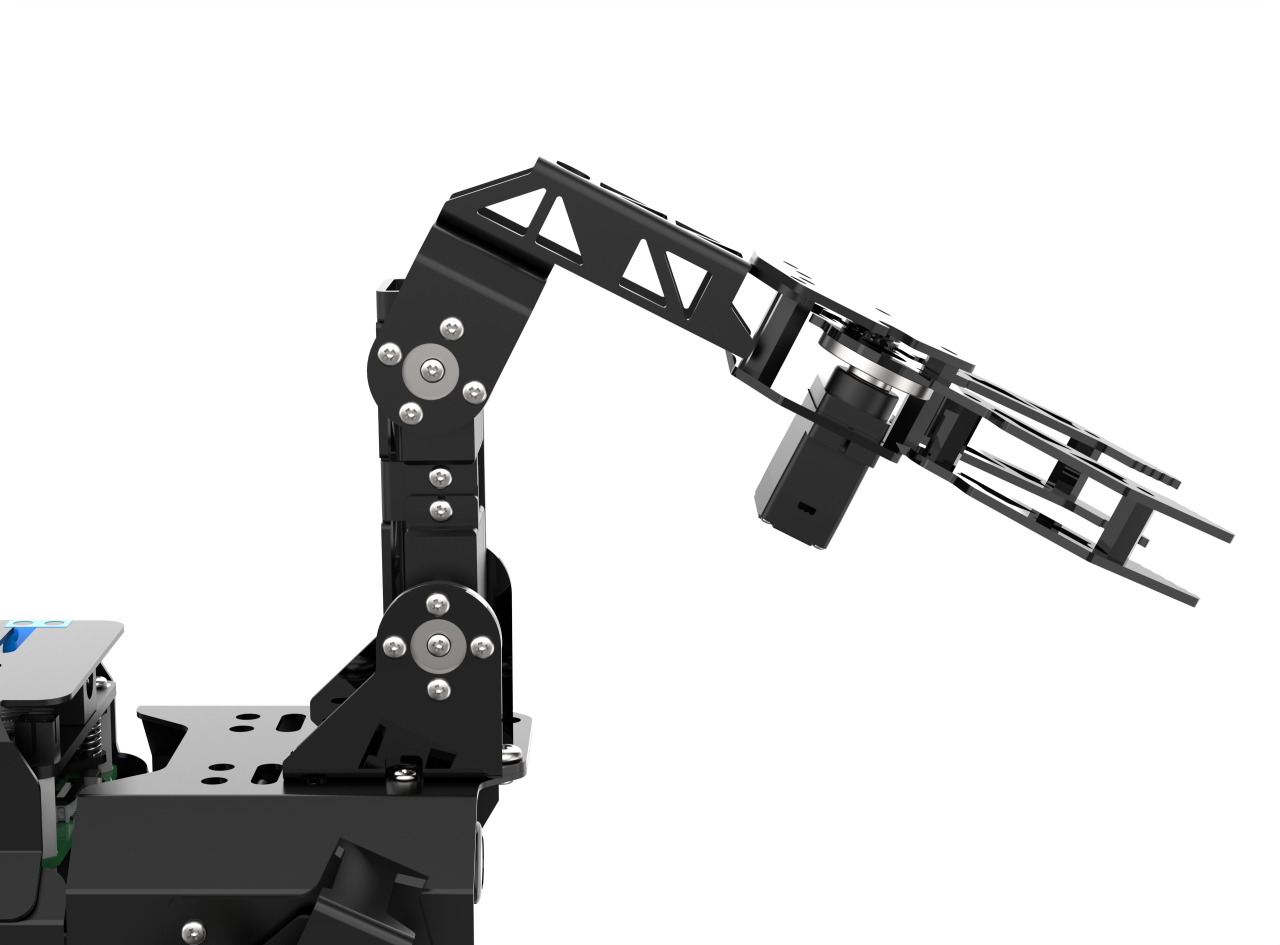
17.3.2 Causes of Offset
Offset may occur under the following conditions:
(1) Incorrect horn installation: If the servo horn is installed while the shaft is not in its neutral (midpoint) position, it can cause an angular deviation. (Note: Servos are factory-calibrated to their midpoint by default.)
(2) Slight mounting misalignment: Even if the horn is installed correctly, small deviations in how the servo is mounted to the bracket can result in minor offsets.
Offsets within ±100 units (approximately ±30°) are considered within the normal adjustment range and can be corrected through software.
Offsets exceeding ±100 units require manual adjustment by removing the horn, repositioning it, and reinstalling it correctly.
17.3.3 Offset Adjustment Steps
Ensure the Reset Servo operation has been performed before proceeding.
(1) Double-click the control software icon  on the desktop.
(2) In the prompt window, click Execute to launch the host software.
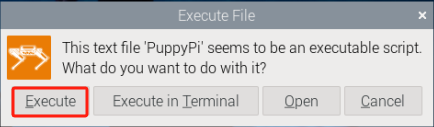
(3) Once the software is open, check the Arm option under Normal Mode to display the servo control panel.

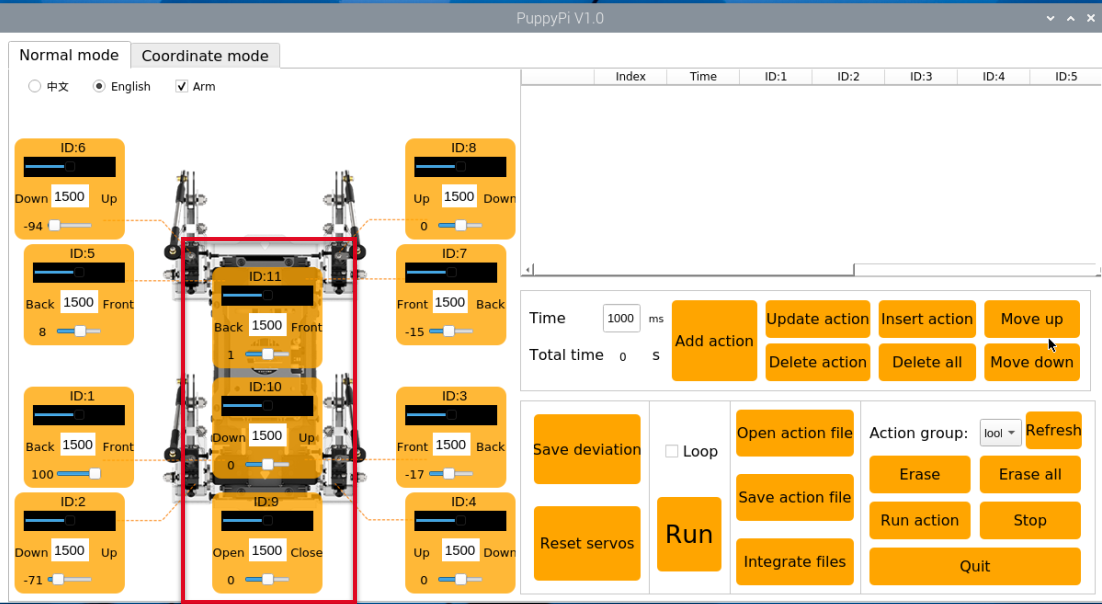
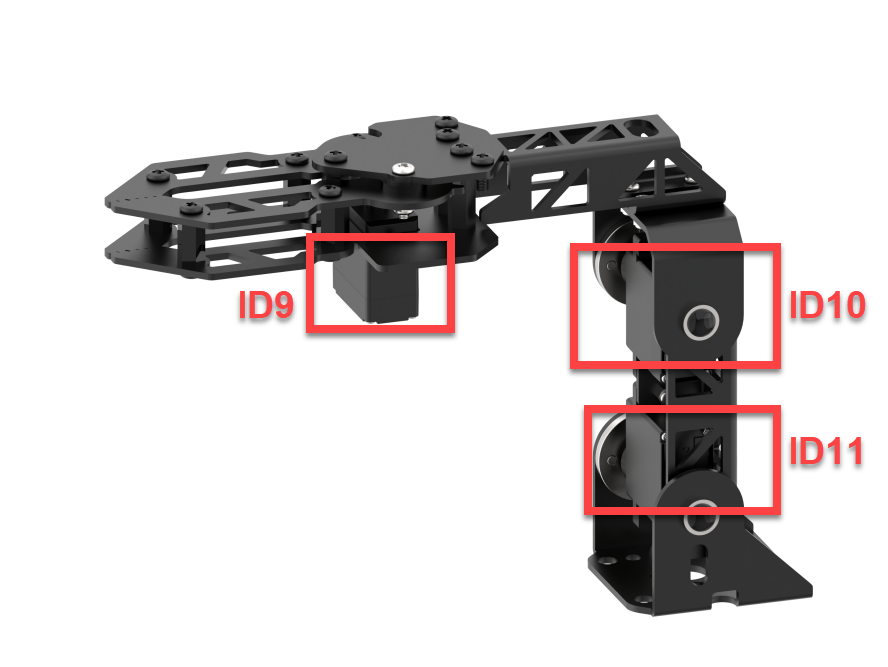
(4) Servos with ID 9, 10, and 11 correspond to the robotic arm’s joints.
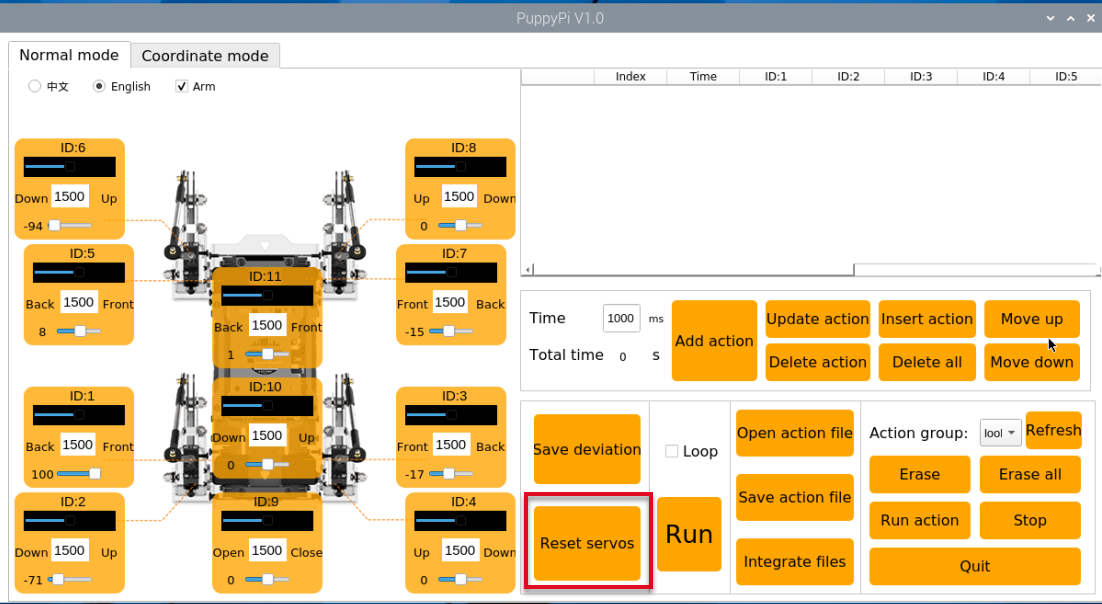
(5) Click the Reset Servo button to bring PuppyPi into its default position.
(6) In Normal Mode, observe the servo positions. If Servo ID10 is misaligned, proceed with adjustment.
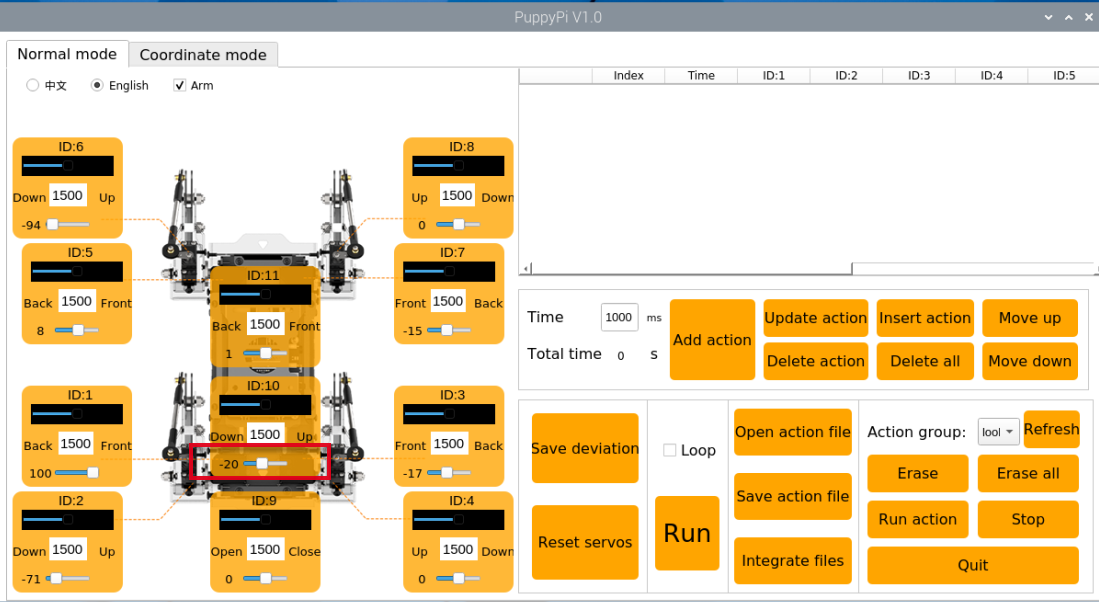
(7) The software will automatically read the current offset value. Use the slider below ID10 to adjust its position until the two connecting rods are perpendicular. You can click the slider or use the mouse scroll wheel to fine-tune the value.
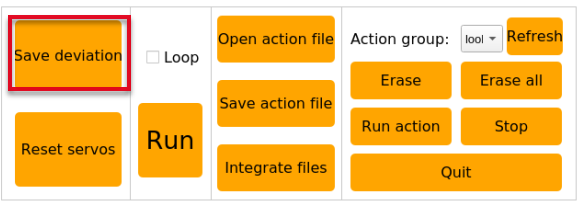
(8) After adjustment, click Save Deviation, then OK to store the offset in the control board.
17.4 Center of Gravity Calibration
17.4.1 Center of Gravity Explanation
The robotic dog’s center of gravity is positioned at the center of its body to ensure balanced weight distribution from front to back and side to side. During movement, the system continuously makes dynamic adjustments to the posture of each component to maintain a stable center of gravity—similar to how a person adjusts their balance when walking with or without carrying a load.
By default, the robot is configured without a robotic arm, and its center of gravity is pre-calibrated at the factory, so no further adjustment is required. However, when a robotic arm is installed, the shift in weight alters the center of gravity. In such cases, users must follow the instructions in this section to manually recalibrate the balance. This helps prevent issues such as body tilting or instability during operation.
17.4.2 Program Configuration Guide
The source code for the ROS1 program is located inside the Docker container at:
/home/ubuntu/puppypi/src/puppy_control/scripts/puppy.py

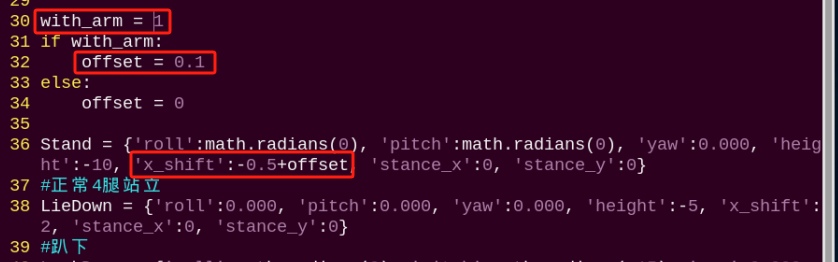
As shown in the figure above, the x_shift parameter in the program defines the distance (in centimeters) by which all four legs of the quadruped robot move along the X-axis in the same direction. This parameter determines the robot’s gait balance point and can be adjusted within a range of -10 to 10.
Note
When with_arm = 0 (i.e., the robot does not have a robotic arm installed), the default value of x_shift is -0.5, which corresponds to the standard center of gravity for the base model.
When adjusting this parameter:
A smaller value shifts the balance point forward, causing the robot to lean slightly forward.
A larger value shifts the balance point backward, causing it to lean slightly toward the rear.
Tuning the x_shift parameter is essential for maintaining walking stability, especially after hardware modifications such as mounting a robotic arm.
17.4.3 Center of Gravity Instructions
Note
Commands are case-sensitive. You may use the Tab key for auto-completion.
(1) Power on the robot, then follow the steps in 3. Remote Tool Installation Connection -> 3.3 Docker Container Introduction and Entry and 3.4 ROS Version Switch Tool Guide to connect via the VNC remote control software and switch to the ROS 2 environment.
(2) Click the icon at the top-left corner  of the desktop to open the Terminator terminal.
(3) Enter the following command to navigate to the control script directory:
cd puppypi/src/puppy_control/scripts
(4) Open the script using the following command:
vim puppy.py
(5) Press the i key to enter insert mode for editing.
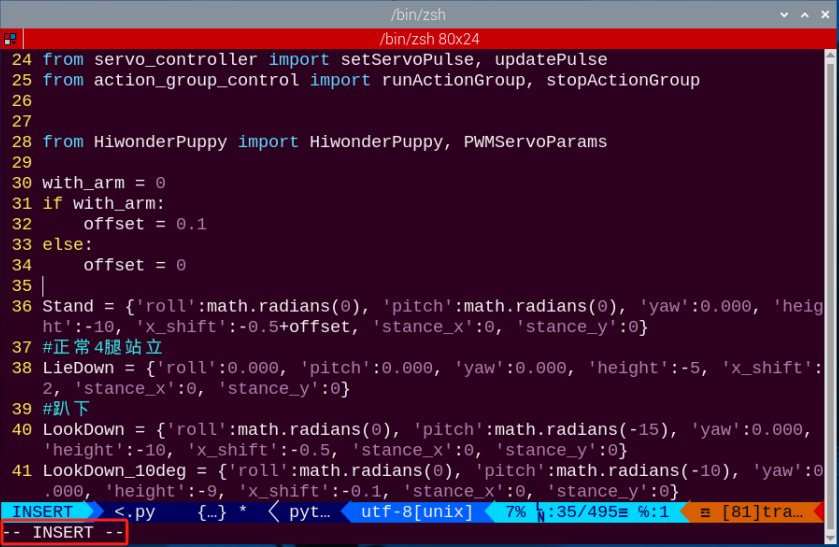
(6) Locate the line with_arm=0 and change it to with_arm = 1. This adjustment sets the offset to 0.1, and modifies the x_shift value to -0.4 (i.e., -0.5 + 0.1). It is recommended to adjust the x_shift value gradually, in increments of ±0.01, for better stability.
(7) After editing, press the Esc key, then type and enter the following command to save and exit:
:wq
(8) Click-on  to open the command-line terminal.
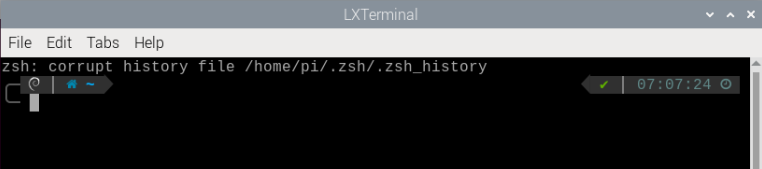
(9) Restart the robot’s startup service to apply the updated settings:
sudo systemctl restart start_node.service
(10) Wait a few moments until you hear a short beep from the buzzer, indicating the system has restarted. Open the terminal again and run the following command to test the walking behavior:
rosrun puppy_control puppy_demo.py
(11) Allow PuppyPi to walk for approximately 5 seconds. If it walks smoothly and maintains balance, the center of gravity has been successfully adjusted.
(12) If instability persists, repeat steps 2 through 11 to continue fine-tuning.
17.5 Robotic Arm Debugging
This document outlines troubleshooting solutions for common issues encountered during PuppyPi’s robotic arm extension activities, such as inaccurate gripping or failure to detect the target object.
Note
While the adjustment procedures for the robotic arm are the same in both ROS1 and ROS2 environments, the steps for launching the activities differ. Please follow the instructions specific to your version.
17.5.1 Adjusting Color Thresholds Using LAB_TOOL
Open the LAB_TOOL software on the Raspberry Pi desktop and verify whether the three sponge blocks used in the activity are correctly detected. If any color is not fully recognized, adjust the corresponding color threshold accordingly. (In the example image, the object to be detected appears white on the left side, while the background appears black, indicating successful color recognition.)
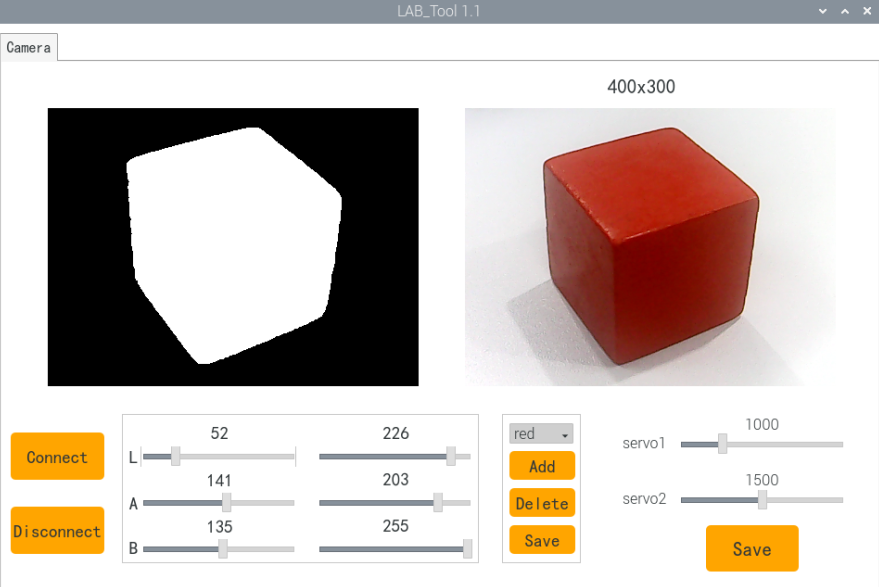
For detailed instructions, please refer to the tutorial saved in: 7.5 ROS1 AI Vision and Tracking Course -> 7.5.1 Color Threshold Adjustment
Acceptance Criteria: All three sponge blocks are accurately and fully detected.
17.5.2 Color Recognition and Grasping Debugging
Note
Before debugging this game, please complete the color threshold adjustments for the three sponge blocks as described in “16.5.1 Adjusting Color Thresholds with LAB_TOOL.”
(1) Power on the robot, then follow the steps in 3. Remote Tool Installation Connection → 3.3 Docker Container Introduction and Entry and 3.4 ROS Version Switch Tool Guide to connect via the VNC remote control software and switch to the ROS 1 environment.
(2) Open the Terminator terminal by clicking the system desktop icon .
(3) Stop the auto-start service by entering the following command and pressing Enter:
~/.stop_ros.sh
(4) Launch the robotic arm gameplay by entering the command below and pressing Enter:
roslaunch puppy_bringup start_node_with_arm.launch
(5) Open a new command-line terminal to enter the following command to launch the color recognition and gripping game.
roslaunch puppy_with_arm color_detect_with_arm.launch
(6) A real-time video window will appear. The yellow rectangular area at the bottom is the recognition zone for the sponge blocks. Place the blue and green sponge blocks inside this zone, ensuring the bottom of each block aligns with the bottom edge of the yellow box (see image reference).
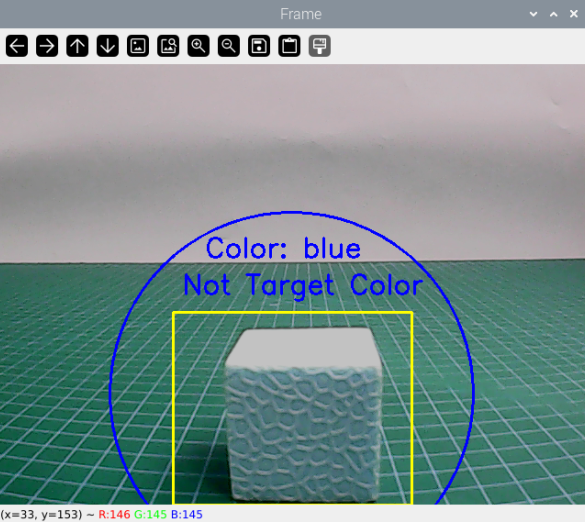
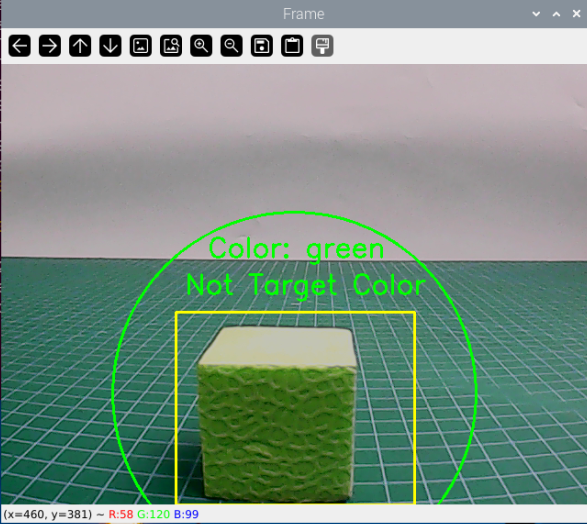
(7) If no recognition box appears around the sponge blocks, the color is not being detected. This may be due to an incorrect minimum color area threshold in the program. To stop the program, press Ctrl + C in the terminal.
(8) Navigate to the program directory by entering:
cd puppypi/src/puppy_with_arm/scripts
(9) Open the gameplay script with:
gedit color_detect_with_arm.py
(10) Scroll to line 127 and check the value of max_area, which defines the minimum recognized area for a single color block. The recommended value is 4000, based on extensive testing.
If the program fails to detect the blocks, try decreasing this value slightly.
Save the file and rerun the program to verify recognition.
Repeat adjustments until all sponge blocks are reliably recognized.

(11) After successful recognition, proceed to test grasping. Place the red sponge block in the recognition zone as described in step 5.
If the robot does not grasp securely or misses the block, check the gripper servo offsets.
Confirm the gripper is fully closed when no grasp command is issued.
Adjust the servo offset as needed.
(12) Once stable grasping is achieved, verify the grasping position. If it is too high, fine-tune the grasp position by adjusting the grab.d6a motion group.
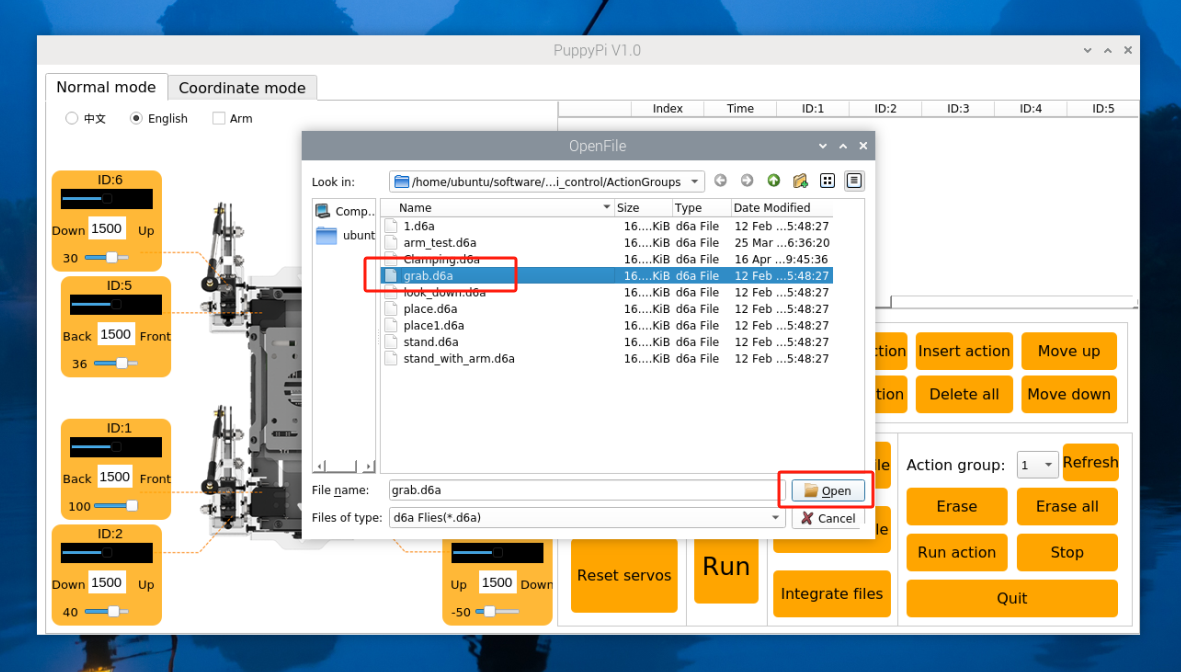
(13) Acceptance Criteria: The game must reliably recognize all three sponge blocks by color and grasp them accurately without dropping during operation.
17.5.3 Line-Following Grasping Debugging
(1) Power on the robot, then follow the steps in 3. Remote Tool Installation Connection → 3.3 Docker Container Introduction and Entry and 3.4 ROS Version Switch Tool Guide to connect via the VNC remote control software and switch to the ROS 1 environment.
(2) Open the LTX terminal  at the top-left corner of the desktop, enter the following command to stop the button service, and press Enter:
sudo systemctl stop button_scan.service
(3) Click the system desktop’s top-left icon  to open the Terminator terminal.
(4) Enter the command below to stop auto-start game services, then press Enter:
~/.stop_ros.sh
(5) Start the line-following grasping gameplay by entering the command and pressing Enter:
roslaunch puppy_with_arm visual_patrol_with_arm.launch
(6) Press the Key1 button on the expansion board to start the game. If the robot fails to grasp the sponge block properly (e.g., grasping too early or too late), stop the program by pressing Ctrl + C in the terminal.
(7) Enter the following command to navigate to the course program directory:
cd puppypi/src/puppy_with_arm/scripts
(8) Open the game script by entering:
gedit visual_patrol_with_arm.py
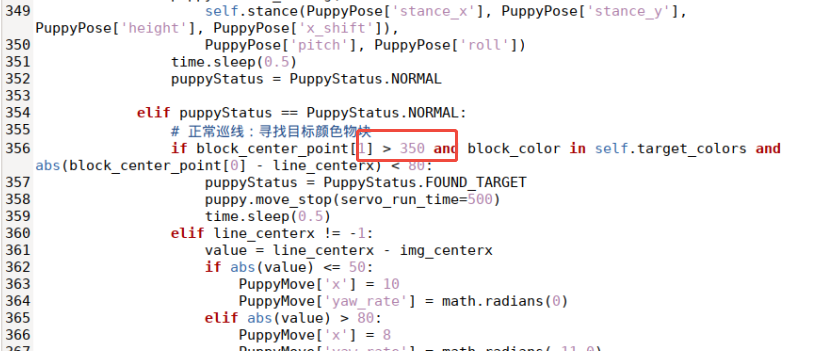
(9) Locate line 355 and adjust the corresponding value:
If Puppypi grasps too late (with the gripper behind the sponge block), increase this value to initiate earlier grasping.
Adjust in increments of about 10 for each modification.
If the robot fails to grasp after increasing the value, it means the value is too high—revert to the previous value and fine-tune in increments of 1.
Test repeatedly until the robot can successfully grasp 3 times consecutively at a given value.
(10) Acceptance Criteria: The game runs successfully and the robot grasps the sponge block correctly 3 times in a row without failure.
17.5.4 Auto Recognition Grasping Debugging
(1) Power on the robot, then follow the steps in 3. Remote Tool Installation Connection → 3.3 Docker Container Introduction and Entry and 3.4 ROS Version Switch Tool Guide to connect via the VNC remote control software and switch to the ROS 1 environment.
(2) Open the LTX terminal at the top-left corner of the desktop, enter the following command to stop the button service, and press Enter:
sudo systemctl stop button_scan.service
(3) Click the system desktop’s top-left icon to open the Terminator terminal.
(4) Enter the command below to stop auto-start gameplay services, then press Enter:
~/.stop_ros.sh
roslaunch puppy_with_arm color_grab.launch
(5) Press the KEY1 button on the Raspberry Pi expansion board to start the program.
If the robot fails to grasp the sponge block correctly (grasping too early or too late), this indicates that the parameter range controlling the grasp action is improperly set.
To stop the program, press Ctrl + C in the terminal.
(6) In the terminal, enter the following command to navigate to the course program directory:
cd puppypi/src/puppy_with_arm/scripts
(7) Open the corresponding gameplay script by running:
gedit visual_patrol_with_arm.py
(8) Within the script:
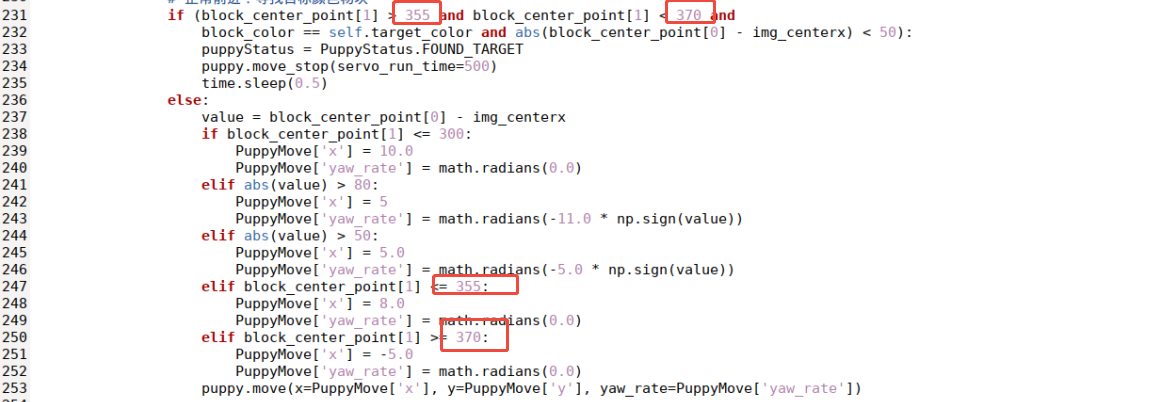
Lines 102 and 117 define the lower limit for
block_center_point[1](e.g., the value 355 in the diagram), which determines when Puppypi moves forward. These two values must be kept consistent—any change to one must be reflected in the other.Lines 102 and 120 define the upper limit for
block_center_point[1](e.g., the value 370), which determines when Puppypi moves backward. This value is typically not changed, but if adjusted, both lines must be updated accordingly.After making any changes, save the file and rerun the gameplay to test the grasping action. The robot should be able to successfully grasp the sponge block three consecutive times.
(9) Acceptance Criteria: The robot consistently grasps the sponge block three times in a row during game.
17.5.5 Follow-up Procedure
After completing the above steps, carefully organize the robotic arm’s servo cables and secure them with cable ties. Make sure to power off the system before handling the cables.
Acceptance Criteria: Move each servo of the robotic arm to its full range of motion repeatedly, and check that none of the servo cables become loose or disconnected.
Once the cable management is confirmed secure, the robotic arm can be safely removed. This completes the entire debugging process.
17.6 Color Recognition Gripping
17.6.1 Program Logic
First, subscribe to the topic messages published by the camera node to obtain real-time image data. Then, convert the RGB color space to grayscale and read the camera’s intrinsic parameters.
Next, perform thresholding, erosion, and dilation on the image to obtain the largest contour of the target color within the image, and outline the detected color.
Finally, control the PuppyPi to perform feedback actions. When red is detected, control the robot to perform the grasping action.
17.6.2 Operation Steps
Note
Command input must strictly differentiate between uppercase and lowercase letters as well as spaces.
(1) Turn on PuppyPi, and connect it to Raspberry Pi desktop via VNC.
(2) Click the icon  on the upper left corner to open the Terminator terminal.
(3) Input the following command and press Enter to close auto-start program.
sudo ./.stop_ros.sh
(4) Input the following command and press Enter start robotic arm game.
roslaunch puppy_bringup start_node_with_arm.launch
(5) Launch a new terminal window, enter the command to activate the color recognition and object-grasping feature, and press Enter to start the function.
roslaunch puppy_with_arm color_detect_with_arm.launch
(6) To close this program, press Ctrl+C in the LX terminal interface. If closing fails, try pressing multiple times.
(7) After closing the program, you still need to enter the following command and press Enter to start the app auto-start service.
sudo systemctl restart start_node.service
After startup completion, the buzzer will emit a short beep sound beep.
Note
If the app auto-start service is not initiated, it will affect the normal implementation of the corresponding game in the app. If the command for auto-start is not entered, restarting the robot will also initiate the app auto-start service again.
17.6.3 Program Outcome
Note
After starting the game, please ensure that there are no other objects with the recognized color within the field of view of the camera, to avoid affecting the implementation effect of the game.
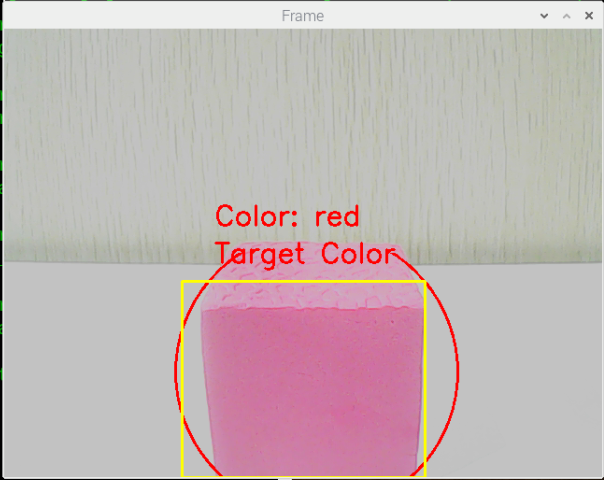
After starting the game, place the color block in front of PuppyPi. When the color block is recognized, it will be identified with a circle in the corresponding color, and the color name will be printed in the center of the window. The program can recognize color blocks of red, blue, and green, but only performs grasping operation on red color blocks.
Note
If the color recognition is inaccurate, please refer to 7.5 ROS1 AI Vision and Tracking Course -> 7.5.1 Color Threshold Adjustment for adjustment.
17.6.4 Program Analysis
Note
Before making any program modifications, it is essential to backup the original factory program. Avoid directly modifying the source code files to prevent accidentally changing parameters in the wrong way, leading to robot malfunctions that cannot be repaired!
Launch File Analysis
During the execution of the functionality, the launch file of the current package will be started (color_detect_with_arm.launch) as pictured:
1 2 3 4 5 | <launch> <node name="color_detect_with_arm" pkg="puppy_with_arm" type="color_detect_with_arm.py" required="false" output="screen" /> </launch> |
From the above diagram, it can be seen that the node name for this game functionality is color_detect_with_arm, and this node is located in the package puppy_with_arm. The node displays the processed information through the terminal.
Finally, the color recognition and gripping function is executed by calling the source code file color_detect_with_arm.py.
Source Code Program Analysis
The source code of this program is stored at: /home/ubuntu/puppypi/src/puppy_with_arm/scripts/color_detect_with_arm.py
4 5 6 7 8 9 10 11 12 13 14 15 16 17 | import sys import cv2 import math import rospy import time import threading import numpy as np from threading import RLock, Timer from ros_robot_controller.msg import BuzzerState from std_srvs.srv import * from std_msgs.msg import Float32,Header from sensor_msgs.msg import Image from puppy_control.srv import SetRunActionName from common import Misc |
① sys is used for handling command-line arguments and exiting the program;
② cv2 is used for OpenCV image processing;
③ math is used for mathematical calculations;
④ rospy is used for ROS communication;
⑤ time is used for timing and delays;
⑥ threading is used for implementing parallel processing;
⑦ Rlock、Time are used for thread synchronization;
⑧ Import service types from std_srvs.srv.
⑨ Import message types from sensor_msgs.msg.
⑩ Import corresponding message types and service types from hiwonder_interfaces;
⑪ Import ROS image message module from sensor_msgs.msg for processing image messages;
⑫ Import action groups from puppy_control.srv.
Main Program
206 207 208 209 210 211 212 213 214 215 216 217 218 219 220 | if __name__ == '__main__': rospy.init_node(ROS_NODE_NAME, log_level=rospy.DEBUG) color_range_list = rospy.get_param('/lab_config_manager/color_range_list', {}) rospy.Subscriber('/usb_cam/image_raw', Image, image_callback) runActionGroup_srv = rospy.ServiceProxy('/puppy_control/runActionGroup', SetRunActionName) buzzer_pub = rospy.Publisher('/ros_robot_controller/set_buzzer', BuzzerState, queue_size=1) initMove() rospy.sleep(0.2) try: rospy.spin() except : rospy.loginfo("Shutting down") |
Subscribes to the /usb_cam/image_raw topic to receive image messages and calls the image_callback function for processing. Additionally, it retrieves a list of color ranges from the parameter server and creates proxies for motion control services and a buzzer publisher. Upon execution, the program initializes movement operations and then enters a loop to wait for incoming image messages. If an exception occurs, the program prints the log message Shutting down. The overall logic is to implement image processing and control robot movement within the ROS environment.
(1) Use rospy.Subscriber to create a message subscriber to handle camera information.
209 210 | color_range_list = rospy.get_param('/lab_config_manager/color_range_list', {}) rospy.Subscriber('/usb_cam/image_raw', Image, image_callback) |
The first parameter /usb_cam/image_raw indicates the topic name of image data;
The second parameter Image indicates message type.
The third parameter indicates calling image_callback function to process the returned image.
(2) Create buzzer_pub buzzer publisher. Use rospy.Publisher to create a message publisher.
213 214 | buzzer_pub = rospy.Publisher('/ros_robot_controller/set_buzzer', BuzzerState, queue_size=1) initMove() |
The first parameter /sensor/buzzer indicates the topic name of buzzer control.
The second parameter Float32 indicates message type.
The third parameter queue_size=1 specify the size of message queue.
Image_callback Callback Function
194 195 196 197 198 199 200 201 202 203 | def image_callback(ros_image): image = np.ndarray(shape=(ros_image.height, ros_image.width, 3), dtype=np.uint8, buffer=ros_image.data) # 将自定义图像消息转化为图像(convert the customized image information to image) cv2_img = cv2.cvtColor(image, cv2.COLOR_RGB2BGR) cv2_img = cv2.flip(cv2_img, 1) frame = cv2_img.copy() frame_result = run(frame) cv2.imshow('Frame', frame_result) key = cv2.waitKey(1) |
The following image is a screenshot of the code inside the image_callback callback function:
First, convert the ROS image message to a numpy array format of image data and convert it from RGB format to BGR format. Then, horizontally flip the image and create a copy of the image data for further processing. Next, call a function named run to process the image and obtain the processing result. Finally, use the cv2 module to display the processed image and wait for key input. The overall logic is to process the received image upon receiving the image message and display the processing result in real-time for monitoring and debugging of the image processing algorithm.
Run Image Process Function
The following image is a screenshot of part of the code for the run function:
100 101 102 103 104 105 106 107 108 109 110 111 112 113 114 115 116 117 118 | def run(img): global draw_color global color_list global detect_color global action_finish global target_color size = (320, 240) img_copy = img.copy() img_h, img_w = img.shape[:2] frame_resize = cv2.resize(img_copy, size, interpolation=cv2.INTER_NEAREST) frame_gb = cv2.GaussianBlur(frame_resize, (3, 3), 3) frame_lab = cv2.cvtColor(frame_gb, cv2.COLOR_BGR2LAB) # 将图像转换到LAB空间(convert the image to LAB space) max_area = 0 color_area_max = None areaMaxContour_max = 0 |
First, preprocess the image, including resizing and Gaussian blur. Then, based on the preset color ranges, locate the color blocks in the image and mark them using minimum enclosing circles. Next, based on the matching between the detected color blocks and the target colors, display the corresponding text in the image. The overall logic is to detect target color blocks, mark them, and display text based on image processing and color matching.
(1) Preprocess the image, including resizing, Gaussian blur, and converting RGB colors to LAB space.
109 110 111 112 113 114 | img_copy = img.copy() img_h, img_w = img.shape[:2] frame_resize = cv2.resize(img_copy, size, interpolation=cv2.INTER_NEAREST) frame_gb = cv2.GaussianBlur(frame_resize, (3, 3), 3) frame_lab = cv2.cvtColor(frame_gb, cv2.COLOR_BGR2LAB) # 将图像转换到LAB空间(convert the image to LAB space) |
(2) Iterate through each element in the color range list (color_range_list) for the three colors (red, green, blue), and perform a mask operation on the image based on the specified color range.
122 123 124 125 126 127 128 129 130 | for i in color_range_list: if i in ['red', 'green', 'blue']: frame_mask = cv2.inRange(frame_lab, (color_range_list[i]['min'][0], color_range_list[i]['min'][1], color_range_list[i]['min'][2]), (color_range_list[i]['max'][0], color_range_list[i]['max'][1], color_range_list[i]['max'][2])) #对原图像和掩模进行位运算(perform bitwise operation to original image and mask) |
(3) After the mask operation, perform erosion and dilation operations on the image, as well as cropping the image. Then, call the getAreaMaxContour() function for contour detection, and finally find the contour with the largest area and its corresponding color.
131 132 133 134 135 136 137 138 139 140 141 142 143 144 145 | eroded = cv2.erode(frame_mask, cv2.getStructuringElement(cv2.MORPH_RECT, (3, 3))) #腐蚀(corrosion) dilated = cv2.dilate(eroded, cv2.getStructuringElement(cv2.MORPH_RECT, (3, 3))) #膨胀(dilation) dilated[0:120,:] = 0 dilated[:,0:80] = 0 dilated[:,240:320] = 0 # cv2.imshow(i, dilated) contours = cv2.findContours(dilated, cv2.RETR_EXTERNAL, cv2.CHAIN_APPROX_NONE)[-2] #找出轮廓(find out the contour) areaMaxContour, area_max = getAreaMaxContour(contours) #找出最大轮廓(find out the contour with the maximal area) if areaMaxContour is not None: if area_max > max_area:#找最大面积(find out the maximal area) max_area = area_max #print(max_area) color_area_max = i areaMaxContour_max = areaMaxContour |
(4) Calculate the pixel value of the contour and filter out those with less than 8500 to ensure that the recognized colors are target color blocks. Use the cv2.minEnclosingCircle() function to obtain the center point (centerX, centerY) and radius (radius) of the minimum enclosing circle of the contour with the largest area, and use the cv2.circle() function to draw the minimum enclosing circle on the image with the color corresponding to the color block.
146 147 148 149 150 151 152 | if max_area > 4000: # 有找到最大面积,面积取大一点,确保色块放入方块里的面积足够大(the largest ares has been found, to ensure that the color block fits well into the square, use a larger area) ((centerX, centerY), radius) = cv2.minEnclosingCircle(areaMaxContour_max) # 获取最小外接圆(get the minimum circumcircle) centerX = int(Misc.map(centerX, 0, size[0], 0, img_w)) centerY = int(Misc.map(centerY, 0, size[1], 0, img_h)) radius = int(Misc.map(radius, 0, size[0], 0, img_w)) cv2.circle(img, (centerX, centerY), radius, range_rgb[color_area_max], 2)#画圆(draw circle) |
(5) Differentiate the largest color block based on color, and mark the colors as 1 (red), 2 (green), or 3 (blue), and add them to the color_list. By repeatedly checking the length of the color_list, assign the corresponding color value to detect_color and draw_color.
154 155 156 157 158 159 160 161 162 163 164 165 166 167 168 169 170 171 172 173 174 175 176 177 178 179 180 | if color_area_max == 'red': #红色最大(red is the maximal area) color = 1 elif color_area_max == 'green': #绿色最大(green is the maximal area) color = 2 elif color_area_max == 'blue': #蓝色最大(blue is the maximal area) color = 3 else: color = 0 color_list.append(color) if len(color_list) == 3: #多次判断(multiple judgement) # 取平均值(take average value) color = int(round(np.mean(np.array(color_list)))) color_list = [] if color == 1: detect_color = 'red' draw_color = range_rgb["red"] elif color == 2: detect_color = 'green' draw_color = range_rgb["green"] elif color == 3: detect_color = 'blue' draw_color = range_rgb["blue"] else: detect_color = 'None' draw_color = range_rgb["yellow"] print('detect_color is',detect_color) |
(6) Based on the matching between the detected color (detect_color) and the target color (target_color), use the cv2.putText() function to draw the text Color: + detect_color on the image, with the position (225, 210), font cv2.FONT_HERSHEY_SIMPLEX, size 1, color draw_color, line width 2, and return the processed image.
185 186 187 188 189 190 191 | if detect_color == target_color: cv2.putText(img, "Target Color" , (225, 250), cv2.FONT_HERSHEY_SIMPLEX, 1, draw_color, 2) else: cv2.putText(img, "Not Target Color" , (200, 250), cv2.FONT_HERSHEY_SIMPLEX, 1, draw_color, 2) cv2.putText(img, "Color: " + detect_color, (225, 210), cv2.FONT_HERSHEY_SIMPLEX, 1, draw_color, 2) return img |
Move Execute Action Function
The following image is a screenshot of part of the code for the move function:
63 64 65 66 67 68 69 70 71 72 73 74 75 76 77 78 79 80 81 82 83 84 85 86 87 88 89 90 91 92 93 94 95 96 97 | def move(): global action_finish global draw_color global detect_color global target_color while not rospy.is_shutdown(): if detect_color == target_color: msg = BuzzerState() msg.freq = 1900 msg.on_time = 0.1 msg.off_time = 0.9 msg.repeat = 1 buzzer_pub.publish(msg) action_finish = False rospy.sleep(0.8) runActionGroup_srv('grab.d6a', True) rospy.sleep(0.5) setServoPulse(9,1200,300) rospy.sleep(0.3) setServoPulse(9,1500,300) runActionGroup_srv('look_down.d6a', True) rospy.sleep(0.8) detect_color = 'None' draw_color = range_rgb["yellow"] action_finish = True rospy.sleep(0.01) runActionGroup_srv('stand_with_arm.d6a', True) # 运行子线程(run sub-thread) th = threading.Thread(target=move,daemon=True) th.start() |
Based on the matching between the detected color and the target color, control the robot to perform the corresponding actions. If the color matches (red), send a buzzer signal of 0.1 second duration using buzzer_pub.publish(0.1), execute a series of actions (grabbing and placing actions), and then reset the detected color to None. If the colors do not match, do not execute the action group.
Execute Sub-thread
95 96 97 | # 运行子线程(run sub-thread) th = threading.Thread(target=move,daemon=True) th.start() |
Create a sub-thread named th and pass the move function as the target function to the sub-thread. Set the daemon parameter to True, indicating that the sub-thread is set as a daemon thread. Use th.start() to start the sub-thread, causing it to begin executing the move function.
By creating a sub-thread and passing the move function as the target function to the sub-thread, it’s possible to execute other tasks in the main thread simultaneously without blocking the execution of the move function. The move function in the sub-thread can execute in the background and can run concurrently with the main thread.
getAreaMaxContour Function
42 43 44 45 46 47 48 49 50 51 52 53 54 | # 找出面积最大的轮廓(find out the contour with the maximal area) # 参数为要比较的轮廓的列表(the parameter is the list of contour to be compared) def getAreaMaxContour(contours): contour_area_temp = 0 contour_area_max = 0 area_max_contour = None for c in contours: # 历遍所有轮廓(iterate through all contours) contour_area_temp = math.fabs(cv2.contourArea(c)) # 计算轮廓面积(calculate the contour area) if contour_area_temp > contour_area_max: contour_area_max = contour_area_temp if contour_area_temp > 50: # 只有在面积大于50时,最大面积的轮廓才是有效的,以过滤干扰(only when the area is greater than 50, the contour with the maximal area is valid to filter the interference) area_max_contour = c |
The following image is a screenshot of part of the code for the getAreaMaxContour function:
From a group of contours, find the contour with the largest area. The function iterates through all contours, calculates their areas, and retains the contour with the largest area. Additionally, a condition is added during area calculation to consider only contours with an area greater than or equal to 50, filtering out smaller disturbances. Finally, the function returns the found largest contour and its corresponding area.
17.6.5 Function Extension
When recognizing red, PuppyPi executes action of gripping and placing color block. To change to color to be
(1) Input the following command to edit color recognition gripping program. Then press Enter.
rosed puppy_with_arm color_detect_with_arm.py
(2) Find the code as pictured:
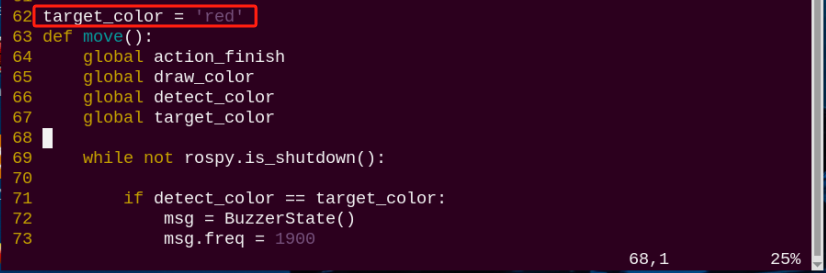
Note
After entering the code position number on the keyboard, press the Shift+G keys to directly navigate to the corresponding position. The code position number shown in the illustration is for reference only, please refer to the actual position.
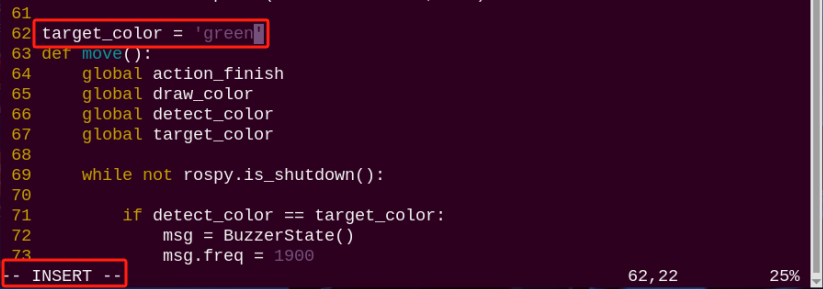
(3) Press i to go to the editing mode. And change red to green.
(4) After modification, press Esc and input :wq. Then press Enter to save and exit.

(5) Refer to 17.6.2 Operation Steps to restart the program to check the modified game effects.
17.7 Auto Recognition Gripping
17.7.1 Program Logic
First, subscribe to the topic messages published by the camera node to obtain real-time image data. Then, convert the RGB color space to grayscale and read the camera’s intrinsic parameters.
Next, perform thresholding, erosion, and dilation on the image to obtain the largest contour of the target color within the image, and outline the detected color.
Then, control the PuppyPi to perform feedback actions. When red is detected, control the robot to perform the grasping action.
Finally, PuppyPi moves forward and then turns left to search for the red placement point. When red is detected, control the robot to perform the placement action, placing the color block at the red placement point.
17.7.2 Operation Steps
Note
Instructions must be entered with strict attention to case sensitivity and spacing.
(1) Turn on PuppyPi, and connect it to Raspberry Pi desktop via VNC.
(2) Click the icon  on the upper left corner, or use shortcut Ctrl+Alt+T to open the LX terminal.
(3) Input command and press Enter to close the auto-start program.
sudo systemctl stop button_scan.service
(4) Click the icon  on the upper left corner to open Terminator terminal.
(5) Input the following command and press Enter to close auto-start program.
sudo ./.stop_ros.sh
(6) Input the following command and press Enter to start the auto-start program.
roslaunch puppy_with_arm color_grab.launch
(7) Pressing KEY1 on the Raspberry Pi expansion board starts autonomous recognition and grasping, while pressing KEY2 can pause the game.
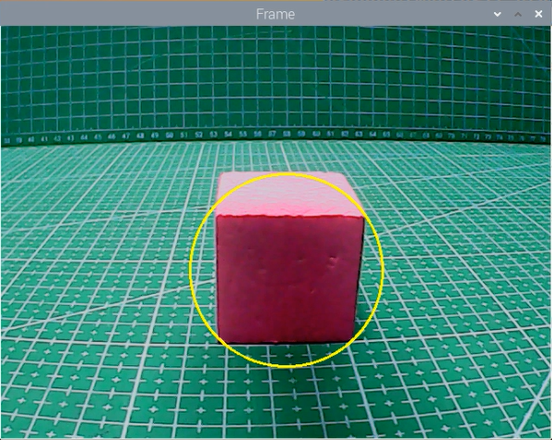
(8) If you need to close this game, you can press Ctrl+C in the LX terminal interface. If closing fails, you can try pressing multiple times.
(9) After closing the game, you also need to enter the following command and press Enter to start the app auto-start service.
sudo systemctl restart start_node.service
After the startup is completed, the buzzer will emit a short beep sound beep.
Note
If the app auto-start service is not enabled, it will affect the normal implementation of the corresponding gameplay in the app. If the command is not entered for auto-start, restarting the robot dog will also restart the app auto-start service.
(10) Additionally, input the following command and press Enter to open the button detection service.
sudo systemctl restart button_scan.service
17.7.3 Program Outcome
After the game is initiated, the recognized red color block will be outlined in the feedback screen. PuppyPi will move towards the color block, grasp it, take a small step forward after grasping, then turn left, and proceed to search for the placement point. Here, we use a red box as the placement point (you can choose according to your preference). Once the red box is found, the color block will be placed inside the box.
Note
If the color recognition is inaccurate, please refer to 7.5 ROS1 AI Vision and Tracking Course -> 7.5.1 Color Threshold Adjustment for adjustment.
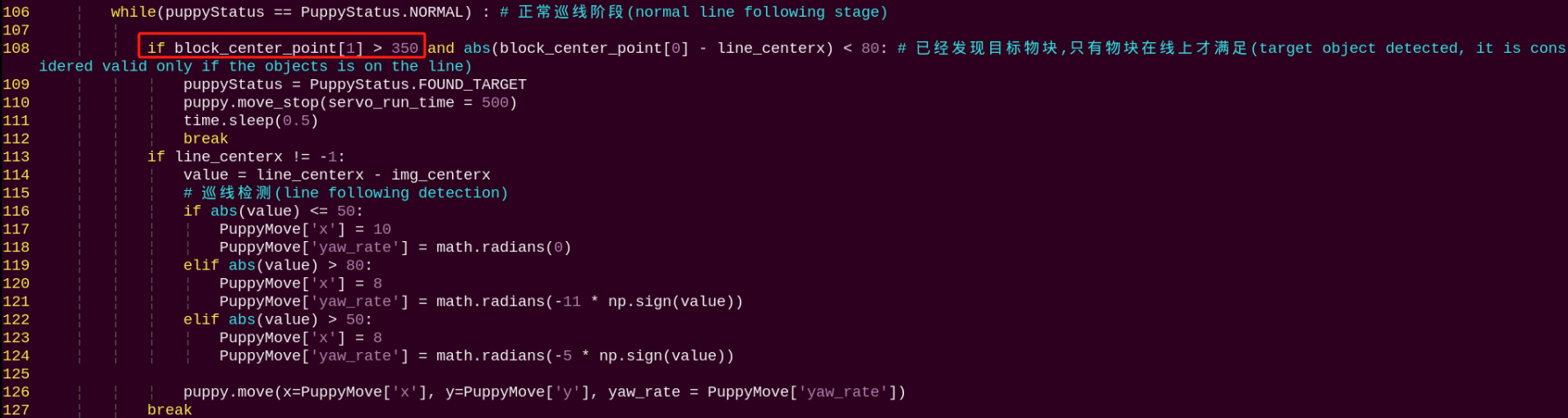
If the gripping position is inaccurate, you can modify the parameter block_center_point[1] in the program. A larger value will move the gripper towards the rear, while a smaller value will move it towards the front. Adjusting this parameter will help to fine-tune the gripping position.
17.7.4 Program Analysis
Launch File Analysis
The source code of this program is stored at /home/ubuntu/puppypi/src/puppy_with_arm/launch/color_grab.launch
<launch>

    <node name="color_grab" pkg="puppy_with_arm" type="color_grab.py" required="false" output="screen" />

</launch>
The <node> tag is used to launch a node named color_grab, which is the main source file for the game. Its definition is as follows:
name=color_grab: Set the node name to color_grab.
pkg=puppy_with_arm:Specify the software package that the node belongs to as puppy_with_arm.
type=color_grab.py:It indicates the execution of an executable file named color_grab.py.
required=false:Similar to the first node, setting it to false means that its failure to start will not affect the entire launch process.
output=screen:The output of the node will be displayed on the screen.
Source Code Program Analysis
The source code of this program is stored at: /home/ubuntu/puppypi/src/puppy_with_arm/scripts/color_grab.py
Import Related Application Library
4 5 6 7 8 9 10 11 12 13 14 15 16 | import sys import cv2 import time import math import threading import numpy as np from enum import Enum from arm_kinematics.ArmMoveIK import ArmIK from common import Misc from common import Camera from common import yaml_handle import gpiod |
① sys is used for handling command-line arguments and exiting the program;
② cv2 is used for OpenCV image processing;
③ math is used for mathematical calculations;
④ rospy is used for ROS communication;
⑤ time is used for timing and delays;
⑥ threading is used for implementing parallel processing;
⑦ Import Raspberry Pi GPIO library
19 20 21 22 | sys.path.append('/home/ubuntu/software/puppypi_control/') from servo_controller import setServoPulse from action_group_control import runActionGroup, stopActionGroup from HiwonderPuppy import HiwonderPuppy, PWMServoParams |
A variable named HomePath is defined to represent the main directory path as /home/pi. Then, /home/pi/PuppyPi_PC_Software is added to Python’s module search path using sys.path.append.
The function setServoPulse is imported from the module ServoCmd. This indicates that the ServoCmd module contains a function named setServoPulse, which is used to control the pulse signal of servo motors.
The functions runActionGroup and stopActionGroup are imported from the ActionGroupControl module. These functions can now be used directly in the current code without needing to call them with the full module name.
The HiwonderPuppy and PWMServoParams classes are imported from the HiwonderPuppy module. Instances of HiwonderPuppy and PWMServoParams are created in the current code, allowing their methods and properties to be used.
Main Program
319 320 321 322 323 324 325 326 327 328 329 330 331 332 333 334 | if __name__ == '__main__': puppy.stance_config(stance(PuppyPose['stance_x'],PuppyPose['stance_y'],PuppyPose['height'],PuppyPose['x_shift']), PuppyPose['pitch'], PuppyPose['roll']) puppy.gait_config(overlap_time = GaitConfig['overlap_time'], swing_time = GaitConfig['swing_time'] , clearance_time = GaitConfig['clearance_time'], z_clearance = GaitConfig['z_clearance']) # overlap_time:4脚全部着地的时间,swing_time:2脚离地时间,z_clearance:走路时,脚抬高的距离(overlap_time: The time when all four feet touch the ground, swing_time: The time when two feet are off the ground, z_clearance: The height at which the feet are lifted during walking) puppy.start() # 启动(start) puppy.move_stop(servo_run_time = 500) AK.setPitchRangeMoving((8.51,0,3.3),500) setServoPulse(9,1500,500) time.sleep(0.5) Debug = False |
Initialize the stance and gait configurations by calling the stance_config and gait_config methods on the puppy object. Start the robot dog with puppy.start(). Set the Debug mode to determine whether the robot dog should move. Open the camera to capture images. In the main loop, continuously capture images and call the run() function for image processing. The overall logic is to complete the program environment initialization, image acquisition and display, and state machine control running loop. Use the Debug mode to decide whether to enable the robot for line following and object grasping tasks.
(1) Use puppy.stance_config to configure the stance of the robot dog’s four legs in a stationary state.
321 | puppy.stance_config(stance(PuppyPose['stance_x'],PuppyPose['stance_y'],PuppyPose['height'],PuppyPose['x_shift']), PuppyPose['pitch'], PuppyPose['roll']) |
The first parameter PuppyPose['stance_x'] indicates the additional separation distance of the four legs on the X-axis, in centimeters.
The second parameter PuppyPose['stance_y'] indicates the additional separation distance of the four legs on the Y-axis, in centimeters.
The third parameter PuppyPose['height'] indicates the height of the dog, which is the vertical distance from the tips of the feet to the leg pivot axis, in centimeters.
The fourth parameter PuppyPose['x_shift'] represents the distance that all legs move in the same direction along the X-axis. The smaller the value, the more the dog leans forward while walking; the larger the value, the more it leans backward.
The fifth parameter PuppyPose['pitch'] represents the pitch angle of the robot dog’s body, in radians.
The sixth parameter PuppyPose['roll'] represents the roll angle of the robot dog’s body, in radians.
(2) Use puppy.gait_config to configure the parameters for the gait motion of the robot fog.
322 323 324 | puppy.gait_config(overlap_time = GaitConfig['overlap_time'], swing_time = GaitConfig['swing_time'] , clearance_time = GaitConfig['clearance_time'], z_clearance = GaitConfig['z_clearance']) # overlap_time:4脚全部着地的时间,swing_time:2脚离地时间,z_clearance:走路时,脚抬高的距离(overlap_time: The time when all four feet touch the ground, swing_time: The time when two feet are off the ground, z_clearance: The height at which the feet are lifted during walking) |
The first parameter overlap_time represents the time during which all four legs are simultaneously in contact with the ground.
The second parameter swing_time represents the time duration for a single leg to swing off the ground.
The third parameter clearace_time represents the time interval between the front and rear legs.
The fourth parameter z_clearance represents the height of the feet off the ground during the gait process.
(3) Start the robot dog, set its initial posture, and trigger the buzzer to sound.
326 327 328 329 330 331 | puppy.start() # 启动(start) puppy.move_stop(servo_run_time = 500) AK.setPitchRangeMoving((8.51,0,3.3),500) setServoPulse(9,1500,500) time.sleep(0.5) |
(4) Set the Debug variable to toggle between Running modes. If Debug is True, it’s a non-real-time mode where only image processing is performed while the robot dog remains stationary. If Debug is False, it’s a real-time mode where both image processing and robot dog line following and object grasping tasks are performed simultaneously.
336 337 338 339 340 341 342 343 344 345 | if Debug: PuppyPose = Bend.copy() puppy.stance_config(stance(PuppyPose['stance_x'],PuppyPose['stance_y'],PuppyPose['height'],PuppyPose['x_shift']), PuppyPose['pitch'], PuppyPose['roll']) time.sleep(0.5) else: th.start() # 开启机器狗移动线程(start the moving thread of robot dog) # 如果只是想看摄像头画面,调试画面,不想让机器人移动,可以把Debug设置为True,同时不要去按按钮(if you only want to view the camera feed and debug the image without moving the robot, you can set Debug to True, and avoid pressing any buttons) # 等调试完再把Debug设置为False,观察实际运行情况(once debugging is complete, set Debug to False, and observe the actual operation) |
(5) Enter the real-time image processing loop. Capture images from the camera, run processing functions on the images, and display the processed images. Additionally, detect the states of two buttons to set the robot dog’s state to start or stop. Continue looping until the user presses Crtl+C to exit. Finally, close the camera and release resources.
326 327 328 329 330 331 332 333 334 335 336 337 338 339 340 341 342 343 344 345 346 347 348 | while True: img = my_camera.frame if img is not None: frame = img.copy() Frame = run(frame) cv2.imshow('Frame', Frame) key = cv2.waitKey(1) if key == 27: break else: time.sleep(0.01) if key1.get_value() == 0: time.sleep(0.05) if key1.get_value() == 0: puppyStatus = PuppyStatus.START if key2.get_value() == 0: time.sleep(0.05) if key2.get_value() == 0: puppyStatus = PuppyStatus.STOP stopActionGroup() my_camera.camera_close() cv2.destroyAllWindows() |
Stance Function
311 312 313 314 315 316 317 | def stance(x = 0, y = 0, z = -11, x_shift = 2):# 单位cm(unit: cm) # x_shift越小,走路越前倾,越大越后仰,通过调节x_shift可以调节小狗走路的平衡(the smaller the x_shift, the more forward-leaning the walk; the larger, the more backward-leaning. Adjusting x_shift can balance the robot dog's gait) return np.array([ [x + x_shift, x + x_shift, -x + x_shift, -x + x_shift], [y, y, y, y], [z, z, z, z], ])#此array的组合方式不要去改变(please refrain from altering the combination of this array) |
By changing the parameters within the function, describe the spatial relationship between the four limbs of the robot dog in various postures. The returned coordinate array serves as a reference for subsequent posture control and motion calculation modules.
getAreaMaxContour Contour Processing Function
215 216 217 218 219 220 221 222 223 224 225 226 227 | # 找出面积最大的轮廓(find out the contour with the maximal area) # 参数为要比较的轮廓的列表(the parameter is the list of contour to be compared) def getAreaMaxContour(contours): contour_area_temp = 0 contour_area_max = 0 area_max_contour = None for c in contours: # 历遍所有轮廓(iterate through all contours) contour_area_temp = math.fabs(cv2.contourArea(c)) # 计算轮廓面积(calculate the contour area) if contour_area_temp > contour_area_max: contour_area_max = contour_area_temp if contour_area_temp >= 5: # 只有在面积大于300时,最大面积的轮廓才是有效的,以过滤干扰(only when the area is greater than 300, the contour with the maximal area is valid to filter the interference) area_max_contour = c |
By comparing the area of contours and filtering out those with an area less than 50, return the contour object along with its corresponding area value.
Run Image Processing Function
231 232 233 234 235 236 237 238 239 240 241 242 243 244 245 246 247 248 249 250 251 252 253 254 255 256 257 258 259 | def run(img): global puppyStatus, block_center_point global block_color global color_list global Debug img_copy = img.copy() img_h, img_w = img.shape[:2] frame_resize = cv2.resize(img_copy, size, interpolation=cv2.INTER_NEAREST) frame_gb = cv2.GaussianBlur(frame_resize, (3, 3), 3) frame_lab_all = cv2.cvtColor(frame_gb, cv2.COLOR_BGR2LAB) # 将图像转换到LAB空间(convert the image to LAB space) max_area = 0 color_area_max = None areaMaxContour_max = 0 for i in lab_data: if i in ['red']: frame_mask = cv2.inRange(frame_lab_all, (lab_data[i]['min'][0], lab_data[i]['min'][1], lab_data[i]['min'][2]), (lab_data[i]['max'][0], lab_data[i]['max'][1], lab_data[i]['max'][2])) #对原图像和掩模进行位运算(perform bitwise operation to original image and mask) eroded = cv2.erode(frame_mask, cv2.getStructuringElement(cv2.MORPH_RECT, (3, 3))) #腐蚀(corrosion) dilated = cv2.dilate(eroded, cv2.getStructuringElement(cv2.MORPH_RECT, (3, 3))) #膨胀(dilation) |
Firstly, preprocess the image by resizing and applying Gaussian blur. Then, identify lines in different ROI regions based on predefined color ranges, calculate the center point positions of the line contours, compute the parameters of the circumscribed circles of the largest area color blocks in the image, determine the recognition status, output different recognition results, and display them in the image. The overall logic involves color recognition and contour extraction from the image, calculating key points of lines, and controlling robot dog movement based on recognition results.
(1) Preprocess the image, including resizing and applying Gaussian blur.
241 242 | frame_resize = cv2.resize(img_copy, size, interpolation=cv2.INTER_NEAREST) frame_gb = cv2.GaussianBlur(frame_resize, (3, 3), 3) |
(2) Segment the preprocessed image ROI into three regions: upper, middle, and lower. Convert the RGB color of the image blocks in these three regions to the LAB color space, and perform bitwise operations with the mask.
249 250 251 252 253 254 255 256 257 | for i in lab_data: if i in ['red']: frame_mask = cv2.inRange(frame_lab_all, (lab_data[i]['min'][0], lab_data[i]['min'][1], lab_data[i]['min'][2]), (lab_data[i]['max'][0], lab_data[i]['max'][1], lab_data[i]['max'][2])) #对原图像和掩模进行位运算(perform bitwise operation to original image and mask) |
(3) After the mask operation, perform opening and closing operations on the image using mathematical morphology. Extract the outer contours of the targets using the cv2.findContours() function, and call the getAreaMaxContour() function to detect contours, filtering out those with smaller areas.
258 259 260 261 262 | eroded = cv2.erode(frame_mask, cv2.getStructuringElement(cv2.MORPH_RECT, (3, 3))) #腐蚀(corrosion) dilated = cv2.dilate(eroded, cv2.getStructuringElement(cv2.MORPH_RECT, (3, 3))) #膨胀(dilation) contours = cv2.findContours(dilated, cv2.RETR_EXTERNAL, cv2.CHAIN_APPROX_NONE)[-2] #找出轮廓(find out the contour) areaMaxContour, area_max = getAreaMaxContour(contours) #找出最大轮廓(find out the contour with the maximal area) |
(4) Find the contours of color blocks in the image and filter out those with a maximum contour area less than 200 to improve recognition accuracy. Finally, use the cv2.circle() function to draw the minimum enclosing circle on the image with a yellow color.
263 264 265 266 267 268 269 270 271 272 273 | if areaMaxContour is not None: if area_max > max_area:#找最大面积(find the maximal area) max_area = area_max color_area_max = i areaMaxContour_max = areaMaxContour if max_area > 200: # 有找到最大面积(the maximal area is found) ((centerX, centerY), radius) = cv2.minEnclosingCircle(areaMaxContour_max) # 获取最小外接圆(get the minimum circumcircle) centerX = int(Misc.map(centerX, 0, size[0], 0, img_w)) centerY = int(Misc.map(centerY, 0, size[1], 0, img_h)) radius = int(Misc.map(radius, 0, size[0], 0, img_w)) block_center_point = (centerX,centerY) |
(5) Differentiate the largest color block based on color, marking them as 1 (red), 2 (green), or 3 (blue), and assign the result to block_color. Then, check if weight_sum is not equal to 0. If it is, draw the center point of the image based on the calculated center point coordinates. Finally, return the processed image based on the values of block_center_point and line_centerx.
280 281 282 283 284 285 286 287 288 289 290 291 292 293 294 295 296 297 298 299 300 301 302 303 304 305 306 307 | if color_area_max == 'red': #红色最大(red is the maximal area) color = 1 elif color_area_max == 'green': #绿色最大(green is the maximal area) color = 2 elif color_area_max == 'blue': #蓝色最大(blue is the maximal area) color = 3 else: color = 0 color_list.append(color) if len(color_list) == 3: #多次判断(multiple judgements) # 取平均值(take average value) color = int(round(np.mean(np.array(color_list)))) color_list = [] if color == 1: block_color = 'red' elif color == 2: block_color = 'green' elif color == 3: block_color = 'blue' else: block_color = 'None' else: block_color = 'None' |
Move Execution Action Function
91 92 93 94 95 96 97 98 99 100 101 102 103 104 105 106 107 108 109 110 111 112 113 114 115 116 117 118 119 120 121 122 123 124 125 126 127 128 129 130 | def move(): global line_centerx, puppyStatus, puppyStatusLast, block_center_point global block_color while True: while(puppyStatus == PuppyStatus.START) : # 启动阶段,初始化姿态(startup stage, initialize the posture) puppy.move_stop(servo_run_time = 500) PuppyPose = Bend.copy() puppy.stance_config(stance(PuppyPose['stance_x'],PuppyPose['stance_y'],PuppyPose['height'],PuppyPose['x_shift']), PuppyPose['pitch'], PuppyPose['roll']) time.sleep(0.5) puppyStatus = PuppyStatus.NORMAL break while(puppyStatus == PuppyStatus.NORMAL) : # if block_center_point[1] > 355 and block_center_point[1] < 370 and block_color == 'red' and abs(block_center_point[0] - img_centerx) < 50: # 已经发现目标物块,只有物块在线上才满足(target object has been found, it is considered valid only when the block is on the line) puppyStatus = PuppyStatus.FOUND_TARGET puppy.move_stop(servo_run_time = 500) time.sleep(0.5) break value = block_center_point[0] - img_centerx if block_center_point[1] <= 300: PuppyMove['x'] = 10 PuppyMove['yaw_rate'] = math.radians(0) elif abs(value) > 80: PuppyMove['x'] = 5 PuppyMove['yaw_rate'] = math.radians(-11 * np.sign(value)) elif abs(value) > 50: PuppyMove['x'] = 5 PuppyMove['yaw_rate'] = math.radians(-5 * np.sign(value)) elif block_center_point[1] <= 355: PuppyMove['x'] = 8 PuppyMove['yaw_rate'] = math.radians(0) elif block_center_point[1] >= 370: PuppyMove['x'] = -5 PuppyMove['yaw_rate'] = math.radians(0) puppy.move(x=PuppyMove['x'], y=PuppyMove['y'], yaw_rate = PuppyMove['yaw_rate']) break |
During the startup phase (PuppyStatus.START), the robot dog stops moving and initializes its posture. In the normal forward phase (PuppyStatus.NORMAL), the robot dog’s movement direction and speed are controlled based on the position relationship between the image center point and the color block center point. If a red color block is detected (PuppyStatus.FOUND_TARGET), execute the grasping action, and then turn the robot dog to the left for a certain distance. During the placing phase (PuppyStatus.PLACE), start searching for red placing points. If a red placing point is found, execute the placing action.
getAreaMaxContour Function
215 216 217 218 219 220 221 222 223 224 225 226 227 228 229 | # 找出面积最大的轮廓(find out the contour with the maximal area) # 参数为要比较的轮廓的列表(the parameter is the list of contour to be compared) def getAreaMaxContour(contours): contour_area_temp = 0 contour_area_max = 0 area_max_contour = None for c in contours: # 历遍所有轮廓(iterate through all contours) contour_area_temp = math.fabs(cv2.contourArea(c)) # 计算轮廓面积(calculate the contour area) if contour_area_temp > contour_area_max: contour_area_max = contour_area_temp if contour_area_temp >= 5: # 只有在面积大于300时,最大面积的轮廓才是有效的,以过滤干扰(only when the area is greater than 300, the contour with the maximal area is valid to filter the interference) area_max_contour = c return area_max_contour, contour_area_max # 返回最大的轮廓(return the contour with the maximal area) |
Here is a screenshot of the code for the getAreaMaxContour function:
From a group of contours, find the contour with the largest area. The function iterates through all the contours, calculates their areas, and retains the contour with the largest area. Additionally, a condition is added during area calculation to consider only contours with an area greater than or equal to 5, filtering out smaller disturbances. Finally, the function returns the found largest contour along with its corresponding area.
17.7.5 Function Extension
When recognizing red, PuppyPi executes action of gripping and placing color block. To change to color to be detected, such as the green color block, follow these steps:
(1) Input the following command to edit color recognition gripping program. Then press Enter.
rosed puppy_with_arm color_grab.py
(2) Find the code as pictured:
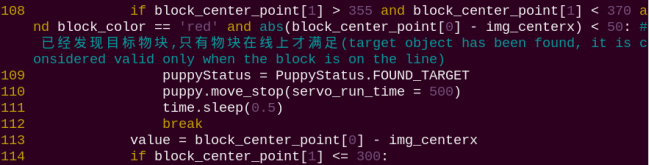
Note
After entering the code position number on the keyboard, press the Shift+G keys to directly navigate to the corresponding position. The code position number shown in the illustration is for reference only, please refer to the actual position.
(3) Press i to go to the editing mode. And change red to green.
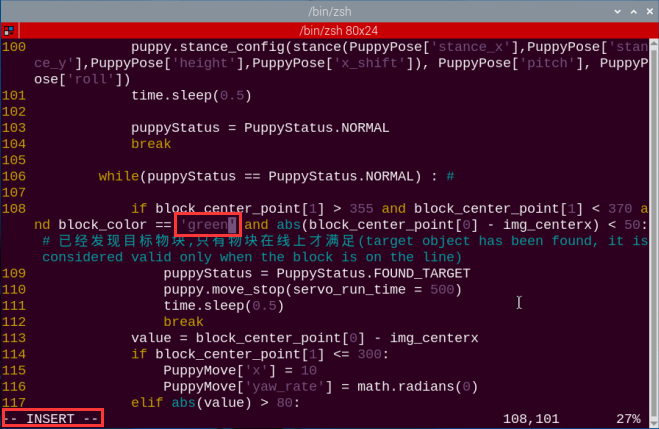
(4) After modification, press Esc and input :wq. Then press Enter to save and exit.

(5) Refer to 17.7.2 Operation Steps to restart the program to check the modified game effects.
17.8 Line Following Gripping
17.8.1 Program Logic
First, it’s necessary to recognize the line colors. Here, we’re using the Lab color space for processing. We’ll convert the image color space from RGB to Lab.
Next, perform operations such as binarization, erosion, and dilation on the image to obtain contours containing only the target color, and mark them with rectangles.
After completing color recognition, calculate based on the feedback of line positions in the image, and control the PuppyPi robot dog to move along the lines, thus achieving autonomous line-following walking.
During line following, if color blocks of the target color are detected, the robot will call action groups to grasp and transport the color blocks. After the transport is completed, it will return to the task of autonomous line following.
17.8.2 Operation Steps
Note
Instructions must be entered with strict attention to case sensitivity and spacing.
(1) Turn on PuppyPi, and connect it to Raspberry Pi desktop via VNC.
(2) Click the icon  on the upper left corner, or use shortcut Ctrl+Alt+T to open the LX terminal.
(3) Input command and press Enter to stop button control service.
sudo systemctl stop button_scan.service
(4) Click the icon  on the upper left corner to open the Terminator terminal.
(5) Input command and press Enter to close auto-start program.
sudo ./.stop_ros.sh
(6) Input the line follow gripping command and press Enter to start the program.
roslaunch puppy_with_arm visual_patrol_with_arm.launch
(7) Press Key1 on the expansion board to start the program.
(8) If you need to close this game, you can press Ctrl+C in the LX terminal interface. If closing fails, you can try pressing multiple times.
(9) After closing the game, you still need to enter the following command and press Enter to start the app’s auto-start service.
sudo systemctl restart start_node.service
After startup is complete, the buzzer will emit a short beep sound, like beep.
Note
If the app’s auto-start service is not initiated, it will affect the normal implementation of the corresponding game in the app. If the command for auto-start is not entered, restarting the robot dog will also restart the app’s auto-start service.
(10) Additionally, you need to input the command and press Enter to start button detection service.
sudo systemctl restart button_scan.service
17.8.3 Program Outcome
Note
After starting the game, please ensure that there are no other objects containing the recognized colors within the field of view of the camera, to avoid affecting the implementation of the game.
After placing the PuppyPi robot dog on a black line, starting the gameplay will prompt the robot dog to move along the black line. If a color block is detected blocking the line ahead, the robot will perform a transport action. It will pick up red color blocks and place them on the left side of the line, and pick up green or blue color blocks and place them on the right side of the line. After completing the pick-up action, it will continue with the line-following task.
Note
If the color recognition is inaccurate, you can refer to 7.5 ROS1 AI Vision and Tracking Course -> 7.5.1 Color Threshold Adjustment to adjust.
If there are instances of inaccurate gripping positions, you can modify the parameter block_center_point[1] in the program. A larger value will position the gripper further back, while a smaller value will position it further forward.
17.8.4 Program Analysis
Note
Before modifying the program, it is essential to back up the original factory program. Avoid making direct modifications in the source code files to prevent unintentional changes to parameters that could lead to robot malfunctions and be irreparable!
Based on the camera feed, obtain real-time visual information and use color thresholding algorithms to extract the color lines required for line following. Calculate the robot’s required movement speed and heading angle based on the offset of the lines in the image, correcting its position to keep the lines centered in the frame in real-time. If a target color block is detected in front of the line-following position, execute a grasping action to place the color block aside and continue with the line-following task.
Launch File Analysis
During the execution of the functionality, the launch file of the current package will be started (color_detect_with_arm.launch) as pictured:
<launch>

    <node name="visual_patrol_with_arm" pkg="puppy_with_arm" type="visual_patrol_with_arm.py" required="false" output="screen" />

</launch>
From the above diagram, it can be seen that the node name for this game functionality is visual_patrol_with_arm, and this node is located in the package puppy_with_arm. The node displays the processed information through the terminal.
Finally, the line following gripping function is executed by calling the source code file visual_patrol_with_arm.py.
Source Code Program Analysis
The source code of this program is stored at: /home/ubuntu/puppypi/src/puppy_with_arm/scripts/visual_patrol_with_arm.py
4 5 6 7 8 9 10 11 12 13 14 15 16 17 18 19 20 21 | import sys import cv2 import time import math import threading import numpy as np from enum import Enum from arm_kinematics.ArmMoveIK import ArmIK from common import Misc from common import Camera from common import yaml_handle import gpiod sys.path.append('/home/ubuntu/software/puppypi_control/') from servo_controller import setServoPulse from action_group_control import runActionGroup, stopActionGroup from HiwonderPuppy import HiwonderPuppy, PWMServoParams |
① sys is used for handling command-line arguments and exiting the program;
② cv2 is used for OpenCV image processing;
③ math is used for mathematical calculations;
④ time is used for timing and delays;
⑤ threading is used for implementing parallel processing;
⑥ numpy is used for scientific computing.
⑦ enum is used to define program running states.
⑧ ArmMoveIK is used to control robotic arm movement.
⑨ pigpio is used for GPIO control, facilitating communication with peripheral hardware.
⑩ Import functions from servoCmd for setting servo pulse width.
⑪ Import action groups from ActionGroupControl.
Main Program
409 410 411 412 413 414 415 416 417 418 419 420 421 422 423 424 | if __name__ == '__main__': puppy.stance_config(stance(PuppyPose['stance_x'],PuppyPose['stance_y'],PuppyPose['height'],PuppyPose['x_shift']), PuppyPose['pitch'], PuppyPose['roll']) puppy.gait_config(overlap_time = GaitConfig['overlap_time'], swing_time = GaitConfig['swing_time'] , clearance_time = GaitConfig['clearance_time'], z_clearance = GaitConfig['z_clearance']) # overlap_time:4脚全部着地的时间,swing_time:2脚离地时间,z_clearance:走路时,脚抬高的距离(overlap_time: The time when all four feet touch the ground, swing_time: The time when two feet are off the ground, z_clearance: The height at which the feet are lifted during walking) puppy.start() # 启动(start) puppy.move_stop(servo_run_time = 500) AK.setPitchRangeMoving((8.51,0,3.3),500) setServoPulse(9,1500,500) time.sleep(0.5) Debug = False |
Initialize the posture and gait settings using the stance_config and gait_config methods of the puppy object, then start the robot dog with puppy.start(). Set the Debug mode to control whether the robot dog moves. Next, open the camera to capture images. In the main loop, continuously capture images and call the run() function for image processing. The overall logic involves initializing the program environment, acquiring and displaying images, running a state machine control loop, and optionally enabling line-following and object grasping tasks based on the Debug mode.
(1) Use puppy.stance_config to configure the stance of the robot dog’s four legs in a stationary state.
411 | puppy.stance_config(stance(PuppyPose['stance_x'],PuppyPose['stance_y'],PuppyPose['height'],PuppyPose['x_shift']), PuppyPose['pitch'], PuppyPose['roll']) |
The first parameter PuppyPose['stance_x'] indicates the additional separation distance of the four legs on the X-axis, in centimeters.
The second parameter PuppyPose['stance_y'] indicates the additional separation distance of the four legs on the Y-axis, in centimeters.
The third parameter PuppyPose['height'] indicates the height of the dog, which is the vertical distance from the tips of the feet to the leg pivot axis, in centimeters.
The fourth parameter PuppyPose['x_shift'] represents the distance that all legs move in the same direction along the X-axis. The smaller the value, the more the dog leans forward while walking; the larger the value, the more it leans backward.
The fifth parameter PuppyPose['pitch'] represents the pitch angle of the robot dog’s body, in radians.
The sixth parameter PuppyPose['roll'] represents the roll angle of the robot dog’s body, in radians.
(2) Use puppy.gait_config to configure the parameters for the gait motion of the robot fog.
412 413 414 | puppy.gait_config(overlap_time = GaitConfig['overlap_time'], swing_time = GaitConfig['swing_time'] , clearance_time = GaitConfig['clearance_time'], z_clearance = GaitConfig['z_clearance']) # overlap_time:4脚全部着地的时间,swing_time:2脚离地时间,z_clearance:走路时,脚抬高的距离(overlap_time: The time when all four feet touch the ground, swing_time: The time when two feet are off the ground, z_clearance: The height at which the feet are lifted during walking) |
The first parameter overlap_time represents the time during which all four legs are simultaneously in contact with the ground.
The second parameter swing_time represents the time duration for a single leg to swing off the ground.
The third parameter clearace_time represents the time interval between the front and rear legs.
The fourth parameter z_clearance represents the height of the feet off the ground during the gait process.
(3) Set the Debug variable to toggle between Running modes. If Debug is True, it’s a non-real-time mode where only image processing is performed while the robot dog remains stationary. If Debug is False, it’s a real-time mode where both image processing and robot dog line following and object grasping tasks are performed simultaneously.
426 427 428 429 430 431 432 433 434 435 | if Debug: PuppyPose = Bend.copy() puppy.stance_config(stance(PuppyPose['stance_x'],PuppyPose['stance_y'],PuppyPose['height'],PuppyPose['x_shift']), PuppyPose['pitch'], PuppyPose['roll']) time.sleep(0.5) puppyStatus = PuppyStatus.NORMAL else: th.start() # 开启机器狗移动线程(start the moving thread of robot dog) # 如果只是想看摄像头画面,调试画面,不想让机器人移动,可以把Debug设置为True,同时不要去按按钮(if you only want to view the camera feed and debug the image without moving the robot, you can set Debug to True, and avoid pressing any buttons) # 等调试完再把Debug设置为False,观察实际运行情况(once debugging is complete, set Debug to False, and observe the actual operation) |
Stance Function
401 402 403 404 405 406 407 | def stance(x = 0, y = 0, z = -11, x_shift = 2):# 单位cm(unit: cm) # x_shift越小,走路越前倾,越大越后仰,通过调节x_shift可以调节小狗走路的平衡(the smaller the x_shift, the more forward-leaning the walk; the larger, the more backward-leaning. Adjusting x_shift can balance the robot dog's gait) return np.array([ [x + x_shift, x + x_shift, -x + x_shift, -x + x_shift], [y, y, y, y], [z, z, z, z], ])#此array的组合方式不要去改变(please refrain from altering the combination of this array) |
The following is a screenshot of the code inside the stance function:

By altering the parameters within the function, describe the spatial relationship of the robot dog’s four limbs in various postures. The returned coordinate array provides reference for subsequent posture control and motion calculation modules.
Run Image Processing Function
249 250 251 252 253 254 255 256 257 258 259 260 261 262 263 264 265 266 267 268 269 | def run(img): global line_centerx global line_color, puppyStatus, block_center_point global block_color global color_list global Debug img_copy = img.copy() img_h, img_w = img.shape[:2] if line_color == (): return img frame_resize = cv2.resize(img_copy, size, interpolation=cv2.INTER_NEAREST) frame_gb = cv2.GaussianBlur(frame_resize, (3, 3), 3) centroid_x_sum = 0 weight_sum = 0 n = 0 |
The following is a screenshot of the code inside the run function:
First, preprocess the image, including resizing and applying Gaussian blur. Then, identify lines in different ROI regions based on predefined color ranges, calculate the center point positions of the line contours, and compute the parameters of the minimum enclosing circle for the largest area color block detected in the image. Based on the judgment of recognition status, output different recognition results such as line center points and color block types, and display them in the image. The overall logic involves color recognition and contour extraction from the image, calculating key points of lines, and outputting recognition results for motion control.
(1) Preprocess the image, including resizing and applying Gaussian blur.
263 264 | frame_resize = cv2.resize(img_copy, size, interpolation=cv2.INTER_NEAREST) frame_gb = cv2.GaussianBlur(frame_resize, (3, 3), 3) |
(2) Segment the preprocessed image ROI into three regions: upper, middle, and lower. Convert the RGB color of the image blocks in these three regions to the LAB color space, and perform bitwise operations with the mask.
266 267 268 269 270 271 272 273 274 275 276 277 278 279 280 281 282 283 284 285 286 287 288 | centroid_x_sum = 0 weight_sum = 0 n = 0 center_x_3 = [None]*3 #将图像分割成上中下三个部分,这样处理速度会更快,更精确(segment the image into top, middle, and bottom sections. This approach will improve processing speed and accuracy) for r in roi: roi_h = roi_h_list[n] n += 1 blobs = frame_gb[r[0]:r[1], r[2]:r[3]] frame_lab = cv2.cvtColor(blobs, cv2.COLOR_BGR2LAB) # 将图像转换到LAB空间(convert the image to LAB space) for i in lab_data: if i in line_color: frame_mask = cv2.inRange(frame_lab, (lab_data[i]['min'][0], lab_data[i]['min'][1], lab_data[i]['min'][2]), (lab_data[i]['max'][0], lab_data[i]['max'][1], lab_data[i]['max'][2])) #对原图像和掩模进行位运算(operate the bitwise operation to original image and mask) |
(3) After the mask operation, perform opening and closing operations on the image using mathematical morphology. Extract the outer contours of the targets using the cv2.findContours() function, and call the getAreaMaxContour() function to detect contours, filtering out those with smaller areas.
289 290 | opened = cv2.morphologyEx(frame_mask, cv2.MORPH_OPEN, np.ones((6, 6), np.uint8)) # 开运算(opening operation) closed = cv2.morphologyEx(opened, cv2.MORPH_CLOSE, np.ones((6, 6), np.uint8)) # 闭运算(closing operation) |
(4) By checking if cnt_large is not empty, it indicates the detection of the target color. Using the cv2.minAreaRect() function, calculate the minimum bounding rectangle of cnt_large and assign the processed result to rect. Then, use the cv2.boxPoints() function to obtain the four vertices of the minimum bounding rectangle and draw this rectangle and its center point on the image. Additionally, add the X-coordinate of the rectangle’s center point to centroid_x_sum based on the weight value for subsequent calculations.
295 296 297 298 299 300 301 302 303 304 305 306 307 308 309 310 311 312 313 314 315 | if cnt_large is not None:#如果轮廓不为空(if contour is not none) rect = cv2.minAreaRect(cnt_large)#最小外接矩形(the minimum bounding rectangle) box = np.int0(cv2.boxPoints(rect))#最小外接矩形的四个顶点(the four vertices of the minimum bounding rectangle) for i in range(4): box[i, 1] = box[i, 1] + (n - 1)*roi_h + roi[0][0] box[i, 1] = int(Misc.map(box[i, 1], 0, size[1], 0, img_h)) for i in range(4): box[i, 0] = int(Misc.map(box[i, 0], 0, size[0], 0, img_w)) cv2.drawContours(img, [box], -1, (0,0,255), 2)#画出四个点组成的矩形(draw the rectangle formed by the four points) #获取矩形的对角点(obtain the diagonal points of the rectangle) pt1_x, pt1_y = box[0, 0], box[0, 1] pt3_x, pt3_y = box[2, 0], box[2, 1] center_x, center_y = (pt1_x + pt3_x) / 2, (pt1_y + pt3_y) / 2#中心点(center point) cv2.circle(img, (int(center_x), int(center_y)), 5, (0,0,255), -1)#画出中心点(draw the center point) center_x_3[n-1] = center_x #按权重不同对上中下三个中心点进行求和(sum the weighted values of the top, middle, and bottom centroids, each with a different weight) centroid_x_sum += center_x * r[4] weight_sum += r[4] |
(5) By checking the value of puppyStatus, it indicates that the robot is currently performing the line-following and object grasping task. Then, the image is converted to the LAB color space. Based on the color threshold ranges defined in lab_data, bitwise operations, erosion, and dilation operations are performed on the image to find color block contours. Contours with a maximum area less than 200 are filtered out to improve recognition accuracy. Finally, the cv2.circle() function is used to draw the minimum enclosing circle on the image with the color corresponding to the color block.
318 319 320 321 322 323 324 325 326 327 328 329 330 331 332 333 334 335 336 337 338 339 340 341 342 343 | if puppyStatus == PuppyStatus.NORMAL : frame_lab_all = cv2.cvtColor(frame_gb, cv2.COLOR_BGR2LAB) # 将图像转换到LAB空间(convert the image to LAB space) max_area = 0 color_area_max = None areaMaxContour_max = 0 for i in lab_data: if i in ['red', 'green','blue']: frame_mask = cv2.inRange(frame_lab_all, (lab_data[i]['min'][0], lab_data[i]['min'][1], lab_data[i]['min'][2]), (lab_data[i]['max'][0], lab_data[i]['max'][1], lab_data[i]['max'][2])) #对原图像和掩模进行位运算(perform bitwise operation to original image and mask) eroded = cv2.erode(frame_mask, cv2.getStructuringElement(cv2.MORPH_RECT, (3, 3))) #腐蚀(corrosion) dilated = cv2.dilate(eroded, cv2.getStructuringElement(cv2.MORPH_RECT, (3, 3))) #膨胀(dilation) contours = cv2.findContours(dilated, cv2.RETR_EXTERNAL, cv2.CHAIN_APPROX_NONE)[-2] #找出轮廓(find out the contour) areaMaxContour, area_max = getAreaMaxContour(contours) #找出最大轮廓(find out the contour with the maximal area) if areaMaxContour is not None: if area_max > max_area:#找最大面积(find the maximal area) max_area = area_max color_area_max = i areaMaxContour_max = areaMaxContour |
(6) Differentiate the largest color block based on color, marking them as 1 (red), 2 (green), or 3 (blue), and assign the result to block_color. Then, check if weight_sum is not equal to 0. If it is, draw the center point of the image based on the calculated center point coordinates. Finally, return the processed image based on the values of block_center_point and line_centerx.
356 357 358 359 360 361 362 363 364 365 366 367 368 369 370 371 372 373 374 375 376 377 378 379 380 381 382 383 384 385 | if color_area_max == 'red': #红色最大(red is the maximal area) color = 1 elif color_area_max == 'green': #绿色最大(green is the maximal area) color = 2 elif color_area_max == 'blue': #蓝色最大(blue is the maximal area) color = 3 else: color = 0 color_list.append(color) if len(color_list) == 3: #多次判断(multiple judgement) # 取平均值(take average value) color = int(round(np.mean(np.array(color_list)))) color_list = [] if color == 1: block_color = 'red' elif color == 2: block_color = 'green' elif color == 3: block_color = 'blue' else: block_color = 'None' if Debug: print('block_color is',block_color) else: block_color = 'None' |
Move Execution Action Function
92 93 94 95 96 97 98 99 100 101 102 103 104 105 106 107 108 109 110 111 112 113 114 115 116 117 118 119 120 121 122 123 124 125 126 127 | def move(): global line_centerx, puppyStatus, puppyStatusLast, block_center_point global block_color while True: while(puppyStatus == PuppyStatus.START) : # 启动阶段,初始化姿态(start stage, initialization posture) puppy.move_stop(servo_run_time = 500) PuppyPose = Bend.copy() puppy.stance_config(stance(PuppyPose['stance_x'],PuppyPose['stance_y'],PuppyPose['height'],PuppyPose['x_shift']), PuppyPose['pitch'], PuppyPose['roll']) time.sleep(0.5) puppyStatus = PuppyStatus.NORMAL break while(puppyStatus == PuppyStatus.NORMAL) : # 正常巡线阶段(normal line following stage) if block_center_point[1] > 350 and abs(block_center_point[0] - line_centerx) < 80: # 已经发现目标物块,只有物块在线上才满足(target object detected, it is considered valid only if the objects is on the line) puppyStatus = PuppyStatus.FOUND_TARGET puppy.move_stop(servo_run_time = 500) time.sleep(0.5) break if line_centerx != -1: value = line_centerx - img_centerx # 巡线检测(line following detection) if abs(value) <= 50: PuppyMove['x'] = 10 PuppyMove['yaw_rate'] = math.radians(0) elif abs(value) > 80: PuppyMove['x'] = 8 PuppyMove['yaw_rate'] = math.radians(-11 * np.sign(value)) elif abs(value) > 50: PuppyMove['x'] = 8 PuppyMove['yaw_rate'] = math.radians(-5 * np.sign(value)) puppy.move(x=PuppyMove['x'], y=PuppyMove['y'], yaw_rate = PuppyMove['yaw_rate']) break |
The following is a screenshot of the code portion inside the move function:
During the startup phase (PuppyStatus.START), the robot dog stops moving and initializes its posture. During normal line-following phase (PuppyStatus.NORMAL), the robot dog’s movement direction and speed are controlled based on the position relationship between the image center point and the block center point. If a color block is detected (PuppyStatus.FOUND_TARGET), the corresponding action group is executed based on the color of the block. If the block is red, the robot first performs the grasping action, then moves to the left side of the line, and finally executes the placing action. If the block is green or blue, the robot first performs the grasping action, then moves to the right side of the line, and finally executes the placing action.
getAreaMaxContour Function
233 234 235 236 237 238 239 240 241 242 243 244 245 246 247 248 | # 找出面积最大的轮廓(find out the contour with the maximal area) # 参数为要比较的轮廓的列表(the parameter is the list of contour to be compared) def getAreaMaxContour(contours): contour_area_temp = 0 contour_area_max = 0 area_max_contour = None for c in contours: # 历遍所有轮廓(iterate through all contours) contour_area_temp = math.fabs(cv2.contourArea(c)) # 计算轮廓面积(calculate the contour area) if contour_area_temp > contour_area_max: contour_area_max = contour_area_temp if contour_area_temp >= 5: # 只有在面积大于300时,最大面积的轮廓才是有效的,以过滤干扰(only when the area is greater than 300, the contour with the maximal area is valid to filter the interference) area_max_contour = c return area_max_contour, contour_area_max # 返回最大的轮廓(return the contour with the maximal area) |
The following is a screenshot of the code portion inside the getAreaMaxContour function:
From a group of contours, find the contour with the largest area. The function iterates through all the contours, calculates their areas, and retains the contour with the largest area. Additionally, a condition is added during area calculation to consider only contours with an area greater than or equal to 5, filtering out smaller disturbances. Finally, the function returns the found largest contour along with its corresponding area.
17.8.5 Function Extension
When the game default recognizes red, the robot dog executes the grasping action group and places the red color block on the left side of the line. When the game default recognizes green, the robot dog executes the grasping action group and places the green color block on the right side of the line. If you need to change the placement position, for example, swapping the positions of the red and green color blocks, you can follow these steps:
(1) Input the following command and press Enter to edit the line following gripping program.
rosed puppy_with_arm visual_patrol_with_arm.py
(2) Find the following code:
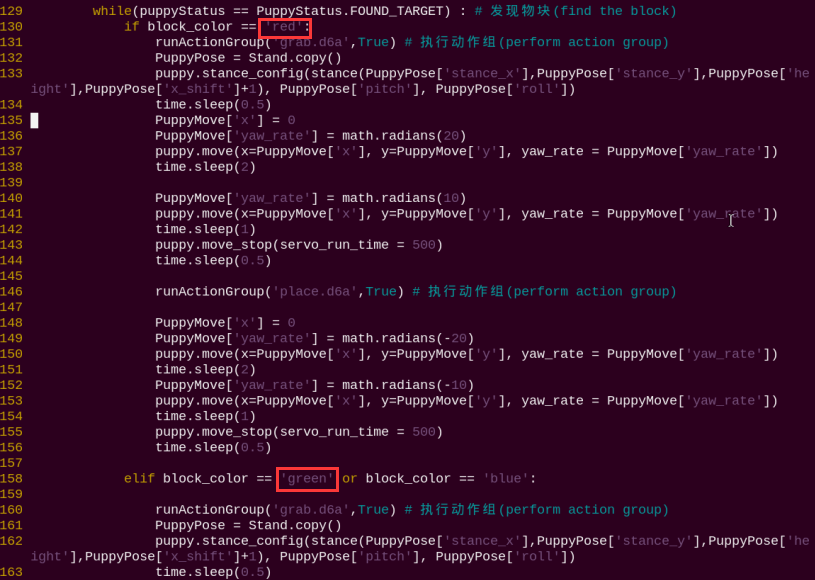
Note
After entering the code position number on the keyboard, press the Shift+G keys to directly navigate to the corresponding position. The code position number shown in the illustration is for reference only, please refer to the actual position.
(3) Press i to go to the editing mode. And swap the positions of the red and green.
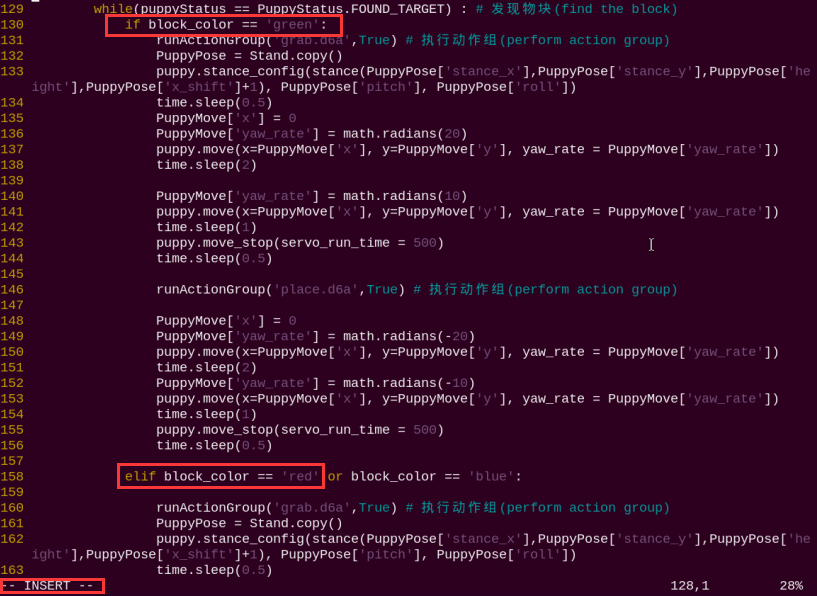
(4) After modification, press Esc and input :wq. Then press Enter to save and exit.

(5) Refer to 17.8.2 Operation Steps to restart the program to check the modified game effects.
17.9 Control Robotic Arm Using Gesture
17.9.1 Program Logic
First, subscribe to the topic messages published by the camera node to obtain real-time image data.
Next, use the Mediapipe library to connect the recognized keypoints of the hand. Normalize the coordinates of the keypoints of the thumb and index finger, then convert them to pixel coordinates in the image. Calculate the distance between these two points.
Finally, the robotic gripper performs opening and closing movements based on the calculated distance.
17.9.2 Operation Steps
Note
Instructions must be entered with strict attention to case sensitivity and spacing.
(1) Turn on PuppyPi, and connect it to Raspberry Pi desktop via VNC.
(2) Click the icon  on the upper left corner to open the Terminator terminal.
(3) Input the following command and press Enter to close the auto-start program.
sudo ./.stop_ros.sh
(4) Input the following command and press Enter to start the program.
roslaunch puppy_with_arm hand_control_with_arm.launch
To reduce memory usage and ensure the normal use of the game here, the camera feed is not displayed. If you want to enable the camera feed, you can follow the steps below.
Note
Before starting the camera feed, ensure that the gesture control gameplay is functioning properly, as otherwise, the camera feed may not start properly.
After starting the game, if the camera feed is not displayed via VNC, you can view the camera feed in a web browser by opening the web_video_server service.
(5) Use any web browser and enter the address 192.168.149.1:8080.

(6) Select the corresponding node’s image to view.
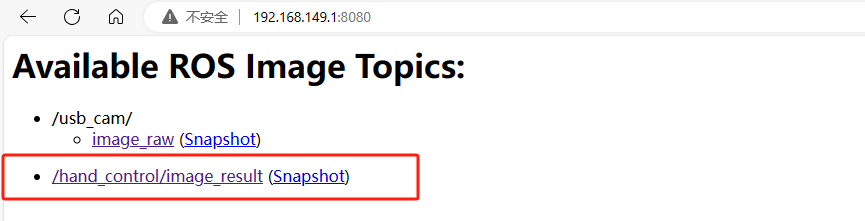
(7) Enter the camera feedback interface for gesture-controlled robotic arm game as pictured:
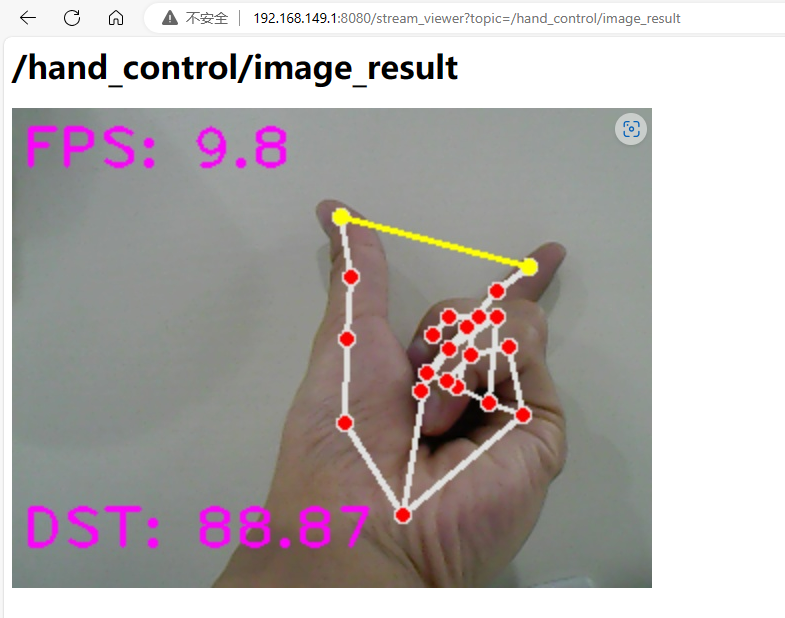
(8) If you need to close this game, you can press Ctrl+C in the LX terminal interface. If closing fails, you can try pressing multiple times.
(9) After closing the game, you still need to enter the command and press Enter to start the app auto-start service.
After the startup is completed, the buzzer will emit a short beep sound beep.
sudo systemctl restart start_ node.service
Note
If the app auto-start service is not enabled, it will affect the normal implementation of the corresponding gameplay in the app. If the command for auto-start is not entered, restarting the robot dog will also restart the app auto-start service.
17.9.3 Program Outcome
After the game starts, when hand features are recognized, they will be connected by dots and lines. A yellow line connects the thumb and index finger, and the distance between them is calculated and displayed in the lower-left corner. The mechanical gripper of Puppypi will follow the changes in distance between the thumb and index finger.
17.9.4 Program Analysis
Launch File Analysis
The source code of this program is stored at /home/ubuntu/puppy_pi/src/puppy_with_arm/launch/hand_control_with_arm.launch
<launch>
    <include file="$(find puppy_bringup)/launch/usb_cam.launch" />

    <node name="puppy_control" pkg="puppy_control" type="puppy.py" required="false" output="screen" />

    <!--摄像头画面网页传输(Webpage transmission of camera images)-->
    <node name="web_video_server" pkg="web_video_server" type="web_video_server" required="true" output="screen" />

    <node name="hand_control" pkg="puppy_with_arm" type="hand_control_with_arm.py" required="false" output="screen" />

</launch>
The <include> tag is used to include the launch file named usb_cam.launch, which is located in the launch folder of the puppy_pi_bringup package. This file contains some tags and configuration parameters related to colors.
The frist <node> tag is used to launch a node named puppy_control which serves as its unique identifier.
pkg=puppy_control:The node belongs to the puppy_control ROS package.
type=puppy_control:Node type is puppy, which indicates the execution of an executable file named web_video_server.
required=false:This node is essential. Setting it to false means that even if this node fails to start, it will not affect the overall execution of the launch file.
output=screen:The output of the specified node will be displayed on the screen.
The second <node> tag is used to launch a node named web_video_server, which is used for camera web transmission. Its definition is as follows:
name=web_video_server:Node name is web_video_server.
pkg=web_video_server:The software package where the node resides is web_video_server.
type=web_video_server:Node type is puppy, which indicates the execution of an executable file named web_video_server.
required=true:This node is not essential. Setting it to true means that if this node fails to start, it will cause the entire launch file to stop.
output=screen:The output of the specified node will be displayed on the screen.
The third <node> tag is used to launch a node named hand_control, which is used to control the robotic arm. Its definition is as follows:
name=hand_control:Then node name is hand_control.
pkg=puppy_with_arm:The software package where the node belongs to is puppy_with_arm.
type=hand_control_with_arm.py:The node type is hand_control_with_arm.py, which indicates running a Python executable file named hand_control_with_arm.py.
required=false:This node is essential. Setting it to false means that even if this node fails to start, it will not affect the overall execution of the launch file.
output=screen:Specify that the output of the node will be displayed on the screen.
Source Code Program Analysis
The source code of this program is stored at: home/ubuntu/puppy_pi/src/puppy_with_arm/scripts/hand_control_with_arm.py
Import Related Application Library
4 5 6 7 8 9 10 11 12 13 14 15 16 17 18 | import sys import cv2 import math import time import rospy import mediapipe as mp from collections import deque import threading import numpy as np from common import Misc from common import PID from std_msgs.msg import Header from sensor_msgs.msg import Image from arm_kinematics.ArmMoveIK import ArmIK from std_srvs.srv import * |
① sys is used for handling command-line arguments and exiting the program;
② cv2 is used for OpenCV image processing;
③ math is used for mathematical calculations;
④ rospy is used for ROS communication;
⑤ time is used for timing and delays;
⑥ mediapipe is used for gesture recognition
⑦ threading is used for implementing parallel processing.
⑧ Misc、PID are used for PID control of robotic arm movement;
⑨ Import service type from std_srvs.srv.
⑩ Import ROS image message module from sensor_msgs.msg for handling image messages;
⑪ Import ArmIK from arm_kinematics.ArmMoveIK for inverse kinematics control;
⑫ Import all service types from the std_srvs.srv package.
20 21 | sys.path.append('/home/ubuntu/software/puppypi_control/') from servo_controller import setServoPulse |
A variable named HomePath is defined to represent the main directory path as /home/ubuntu. Then, /home/ubuntu/PuppyPi_PC_Software is added to Python’s module search path using sys.path.append.
The function setServoPulse is imported from the module ServoCmd. This indicates that the ServoCmd module contains a function named setServoPulse, which is used to control the pulse signal of servo motors.
Distance Calculation Between Two Points
24 25 26 27 28 29 30 31 | def distance(point_1, point_2): """ 计算两个点间的距离(calculate the distance between two points) :param point_1: 点1(point 1) :param point_2: 点2(point 2) :return: 两点间的距离(distance between two points) """ return math.sqrt((point_1[0] - point_2[0]) ** 2 + (point_1[1] - point_2[1]) ** 2) |
Using the Python math library, the Euclidean distance between two points is calculated. It computes the distance between two points (point_1[0], point_1[1]) and (point_2[0], point_2[1]) on a two-dimensional plane.
(point_1[0] - point_2[0]) ** 2 and (point_1[1] - point_2[1]) ** 2: These calculate the squares of the differences in the x and y directions, respectively. Then, these squares are added together to obtain the square of the Euclidean distance.
math.sqrt:Calculate the square root of the sum to obtain the final Euclidean distance.
Coordinates Conversion
33 34 35 36 37 38 39 40 41 42 | def get_hand_landmarks(img, landmarks): """ 将landmarks从medipipe的归一化输出转为像素坐标(convert the landmarks from mediapipe's normalized output to pixel coordinates) :param img: 像素坐标对应的图片(the image corresponding to the pixel coordinates) :param landmarks: 归一化的关键点(normalized key points) :return: """ h, w, _ = img.shape landmarks = [(lm.x * w, lm.y * h) for lm in landmarks] return np.array(landmarks) |
landmarks = [(lm.x * w, lm.y * h) for lm in landmarks]:Using list comprehension, multiply each key point’s x and y coordinates by the width and height of the image, respectively, to obtain the actual coordinates. Here, lm represents the object containing key points.
return np.array(landmarks):Convert the mapped key point coordinates to a NumPy array and return it as the function’s result.
Convert the OpenCV Image to the Image Message of the ROS
44 45 46 47 48 49 50 51 52 53 54 55 56 | def cv2_image2ros(image, frame_id=''): image = image[:,:,::-1] ros_image = Image() header = Header(stamp=rospy.Time.now()) header.frame_id = frame_id ros_image.height = image.shape[:2][0] ros_image.width = image.shape[:2][1] ros_image.encoding = 'rgb8' ros_image.data = image.tostring() ros_image.header = header ros_image.step = ros_image.width * 3 return ros_image |
The function cv2_image2ros converts an image in OpenCV format to the ROS image message format. It first converts the image channels from BGR to RGB, then creates a ROS image message, setting its header information, dimensions, encoding, and data. Finally, it returns the converted ROS image message.
HandControlWithArmNode Class Initialization
58 59 60 61 62 63 64 65 66 67 68 69 70 71 72 73 74 75 76 77 78 79 80 81 82 83 84 | class HandControlWithArmNode: def __init__(self, name): rospy.init_node(name) # launch里的name会覆盖此处的name,所以要修改name,需要修改launch里的name, 为了一致性此处name会和launch name保持一致(the "name" in the "launch" file will override the name here. To change "name", you need to modify it in the "launch" file. For consistency, the name here will match the name in the launch file) self.mpHands = mp.solutions.hands self.hands = self.mpHands.Hands(static_image_mode=False, max_num_hands=1, min_detection_confidence=0.7, min_tracking_confidence=0.7) self.mpDraw = mp.solutions.drawing_utils self.ak = ArmIK() self.last_time = time.time() self.last_out = 0 self.frames = 0 self.window_size = 5 # 定义滑动窗口大小(滤波窗口大小)(define the size of slider window(filter window size)) self.distance_measurements = deque(maxlen=self.window_size) # 创建一个队列用于存储最近的距离测量数据(create a queue to store recent distance measurement data) self.filtered_distance = 0 self.th = threading.Thread(target=self.move,daemon=True) self.th.start() self.name = name self.image = None rospy.Subscriber('/usb_cam/image_raw', Image, self.image_callback) self.result_publisher = rospy.Publisher('~image_result', Image, queue_size=1) # 图像处理结果发布,# 使用~可以自动加上前缀名称(image processing result publish, use "~" can automatically add the prefix name) |
① rospy.init_node(name): Initialize a ROS node. The node name is name.
② self.mpHands = mp.solutions.hands: Import hands module of the mp library.
③ self.hands = self.mpHands.Hands(...): Create a hand detection object configured with parameters such as whether to use static image mode, maximum number of hands, minimum confidence for detection and tracking.
④ self.mpDraw = mp.solutions.drawing_utils: Import the drawing tool module.
⑤ self.ak = ArmIK(): Create a ArmIK object, = is used for inverse kinematics computation.
⑥ self.last_time = time.time(): Record current time.
⑦ self.last_out = 0: Initialize a variable.
⑧ self.frames = 0: Initialize a frame counter.
⑨ self.window_size = 5: Define the size of the sliding window as 5.
self.distance_measurements = deque(maxlen=self.window_size): Create a double-ended queue to store the most recent distance measurement data, with a maximum capacity of 5 data points.
⑩ self.filtered_distance = 0: Initialize a filtered distance variable.
⑪ self.th = threading.Thread(target=self.move,daemon=True): Create a new thread to execute the move method and set it as a daemon thread.
⑫ self.th.start(): Start new thread.
⑬ self.name = name: Assign the passed name value to self.name.
⑭ self.image = None: Initialize a image variable to None.
⑮ rospy.Subscriber('/usb_cam/image_raw', Image, self.image_callback): Subscribe to the ROS topic named /usb_cam/image_raw with the message type Image. When a message is received, call the self.image_callback callback function.
⑯ self.result_publisher = rospy.Publisher('~image_result', Image, queue_size=1): Create a publisher that publishes on the ROS topic named ~image_result, with the message type Image and a queue size of 1.
Image Callback Function
86 87 | def image_callback(self, ros_image): self.image = np.ndarray(shape=(ros_image.height, ros_image.width, 3), dtype=np.uint8, buffer=ros_image.data) # 原始 RGB 画面(original RGB image) |
A callback function named image_callback is defined to handle ROS image messages. It uses NumPy to create an array, converts ROS image data to RGB format, and stores it in the object’s image attribute.
Set the Initial State of Robotic Arm
89 90 91 92 93 | def init(self): setServoPulse(9,1500,300) setServoPulse(10,800,300) setServoPulse(11,850,300) time.sleep(0.3) |
Use setServoPulse function to control servo. Take setServoPulse(9,1500,300) as example here:
The fist parameter 9 is servo ID; the second parameter 1500 is servo pulse-width; the third parameter 300 is the servo running time in ms.
Claw Movement Function
97 98 99 100 101 102 103 104 105 106 107 | def move(self): while not rospy.is_shutdown(): if self.filtered_distance > 0 and self.filtered_distance < 100: out = Misc.map(self.filtered_distance, 15, 90, 1500, 900) setServoPulse(9,int(out),0) else: rospy.sleep(0.001) |
Within the loop, the code checks if the value of self.filtered_distance is between 0 and 100. If it is, some operations are performed:
The Misc.map function is used to map self.filtered_distance to a new range, specifically mapping [15, 90] to [1500, 900]. This mapping is used to scale the measured distance between the two fingers into the range of control signals.
The setServoPulse function is called, passing the mapped value as a parameter to the servo motor. The function takes three parameters: the servo ID, the pulse width, and the time. Setting the time to 0 indicates that the servo will execute a single movement to the target position. This function is used to adjust the position of the claw servo motor.
If the value of self.filtered_distance is not between 0 and 100, the code sleeps for 0.001 seconds using rospy.sleep(0.001).
Main Function
{lineno-start=}
    def run(self):

        self.init()
        while not rospy.is_shutdown():
            if self.image is not None:
                image_flip = cv2.flip(self.image, 1)
                image_re = cv2.resize(image_flip, (320,240), interpolation=cv2.INTER_NEAREST)
                self.image = None
                bgr_image = cv2.cvtColor(image_re, cv2.COLOR_RGB2BGR)
                try:


                    results = self.hands.process(image_re)
                    if results.multi_hand_landmarks:

                        for hand_landmarks in results.multi_hand_landmarks:
                            ## mediapipe中首部关键结点的连线(lines connecting the key points at the beginning of the MediaPipe)
                            self.mpDraw.draw_landmarks(bgr_image, hand_landmarks, self.mpHands.HAND_CONNECTIONS)
                            landmarks = get_hand_landmarks(image_re, hand_landmarks.landmark)

                            cv2.line(bgr_image, (int(landmarks[4][0]), int(landmarks[4][1])), (int(landmarks[8][0]), int(landmarks[8][1])), (0, 255, 255), 2)
                            cv2.circle(bgr_image, (int(landmarks[8][0]), int(landmarks[8][1])), 4, (0, 255, 255), -1)
                            cv2.circle(bgr_image, (int(landmarks[4][0]), int(landmarks[4][1])), 4, (0, 255, 255), -1)

                            distanceSum = distance(landmarks[8], landmarks[4])

                            distanceSum = max(15, min(distanceSum, 90))
                            self.distance_measurements.append(distanceSum)
                            self.filtered_distance = np.mean(self.distance_measurements)
                            self.filtered_distance = round(self.filtered_distance,2)
                            cv2.putText(bgr_image,'DST: '+str(self.filtered_distance), (5,220), cv2.FONT_HERSHEY_PLAIN, 2, (255,0,255), 2)


                    self.frames +=1
                    delta_time = time.time() - self.last_time
                    cur_fps = np.around(self.frames / delta_time, 1)
                    cv2.putText(bgr_image,'FPS: '+str(cur_fps), (5,30), cv2.FONT_HERSHEY_PLAIN, 2, (255,0,255), 2)
                except Exception as e:
                    print(e)


                self.result_publisher.publish(cv2_image2ros(cv2.resize(bgr_image, (640, 480)), self.name))
self.init():Theinitmethod is called to perform some parameter settings and initialize ROS-related components.The main loop
while not rospy.is_shutdown()executes the loop as long as the ROS node is not shut down.if
self.image is not None: Check if there is image data available. If there is image data, perform the following operations:
① Image processing: First, flip the image horizontally. Resize the image to (320, 240). Clear the original image. Finally, convert the RGB format image to BGR format.
② Hand pose detection:
Perform hand pose detection using MediaPipe to obtain the coordinates of hand keypoints, then draw the hand keypoints and connecting lines on the image.
Calculate the distance between fingers, update the distance measurement list
self.distance_measurements, compute the mean distance, updateself.filtered_distance, and display the distance information on the image.
③ Compute the frame rate information: Record the frame count and calculate the frame rate, then display the frame rate information on the image.
④ Publish result image: self.result_publisher.publish(cv2_image2ros(cv2.resize(bgr_image, (640, 480)), self.name)):Publish the processed image via ROS.
17.10 Fixed Point Navigation Handling
Note
Before starting this game, you should have the map constructed. The completeness of the map will affect the navigation effect. You can refer to 15 ROS1-SLAM Mapping Course->15.2 Gmapping Mapping Algorithm for mapping. To ensure the mapping effect, you need to disassemble the robotic arm on the robot or use an PC software to change the posture of the robotic arm. Do not obstruct the LiDAR.
17.10.1 Working Principle
Firstly, start the navigation service and obtain the location information of the destination.
Next, perform navigation path planning to drive to the destination.
Then, subscribe to the topic messages published by the camera node to obtain the image, and perform color recognition.
Finally, locate the placement point and execute action group to control the robotic arm to complete the color block placement task.
17.10.2 The Installation and Configuration of Virtual Machine
Due to the limited computing power of the Raspberry Pi, it is necessary to offload part of the mapping work to a virtual machine. Both mapping and navigation require communication between the virtual machine and the PuppyPi, so we need to modify the configurations of both.
Install Virtual Machine Software
You can refer to the document Virtual Machine Installation in the same directory for instructions on installing the virtual machine.
Open and Import of Virtual Machine
(1) Unzip the virtual machine files from the appendix to any path that does not contain Chinese characters.
(2) Open a virtual machine.
(3) Select the folder where virtual machine file is extracted, then open it.
(4) Enter the name and set the storage path for virtual machine. Then click Import.
Note
After the first importing, you can directly select the storage path for the previous virtual machine, and open it without importing it again.
Network Configuration of Virtual Machine
Note
If you are using desktop computer, please prepare a wireless LAN adapter or USB wireless adapter.
(1) Firstly, start PuppyPi, and join the WiFi created by PuppyPi on computer.
(2) Return to the virtual machine interface, and click edit->virtual machine editor.
(3) Select the wireless network card to be bridged. Then click OK.
(4) Open virtual machine, and power on virtual machine.
(5) When entering the system desktop, right click the desktop and select open in terminal.
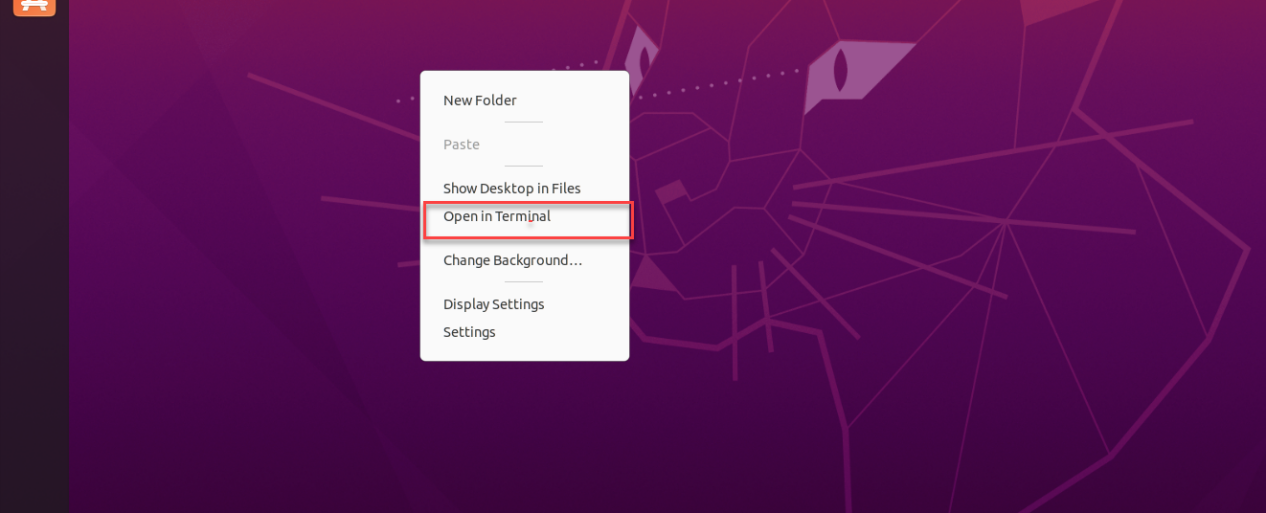
Note
The input command should be case sensitive and the keywords can be complemented by Tab key.
(6) Input the following command and press Enter to check the IP of virtual machine. And the IP is as the red frame shown.
ifconfig
(7) Right click the system desktop, and open a new command line terminal. Then input the following command and press Enter to configure the network.
sudo nano /etc/hosts
(8) Modify the IP in the second and the third lines as the IP of virtual machine and Raspberry Pi you got in the previous step. And the fixed IP of Raspberry Pi under direct connection mode is 192.168.149.1.
Note
When modifying the IP, please ensure the indent is consistent.
(9) After modification, press Ctrl+x, and Y key to save modified buffer, then press Enter.

PuppyPi Network Configuration
(1) Get access to Raspberry Pi desktop via VNC.
(2) Click  or use shortcut Ctrl+Alt+T to open terminal.
(3) Enter the following command and press Enter to change network configuration.
sudo vim /etc/hosts
(4) Find the code marked in the below figure, then enter the IP of virtual machine which can be obtained in step 1.2. After that, press Esc key, enter :wq and press Enter key to save and exit.
(5) Run the command below to update the configuration.
source .bashrc
(6) Open the virtual machine and enter the command to view the relevant topics of the robot. If they are successfully displayed, communication with the robot is successful. If they cannot be displayed successfully, you need to recheck the above steps for errors.
rostopic list
(7) Open the virtual machine and enter the command to synchronize the time with PuppyPi. If the time is not synchronized, it will affect the subsequent navigation effects.
sudo ntpdate 192.168.149.1
If the following error occurs, you can retry several times and check if the network configuration is successful.

17.10.3 Start Navigation
(1) Open the PuppyPi system, open the command prompt, enter the following command, and press Enter to start the basic configuration of the robot.
roslaunch puppy_pi_bringup start_node_nav.launch
(2) Open the PuppyPi system, open the command prompt, enter the following command, and press Enter to start the navigation service of robot.
roslaunch puppy_navigation navigation.launch
Note
By default, the map recorded here is map1.
If the following content appears, the opening is successful:
(3) Click File > New Tab at the top of the terminal window. Since a large volume of data will be generated during the mapping process, placing fast-refreshing tabs at the bottom of the terminal interface helps reduce system load and conserve computing resources.
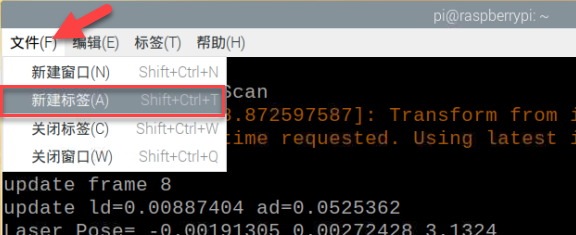
If you encounter a memory-related error (as shown below), it is caused by insufficient system memory. This does not affect the functionality of the gameplay and can be safely ignored.

(4) On the PuppyPi system, open a terminal and enter the following command to launch the navigation-based object placement feature:
No output will appear in the terminal immediately. Status messages will be displayed only after the robot successfully reaches a navigation point.
rosrun puppy_with_arm color_place_nav.py
(5) Open a terminal in the virtual machine and run the corresponding command to start the parameter server. Starting the parameter server is essential. Without it, the robot’s joints will not be driven, and its joint movements will not be visible in RVIZ.

(6) Open a new command line terminal window, enter the following command to start the model viewing software, and press Enter.
roslaunch puppy_description rviz_with_urdf.launch
(7) Click File->Open Config.
As shown in the following image, navigate to the corresponding path, select navigation.rviz, and then click Open.
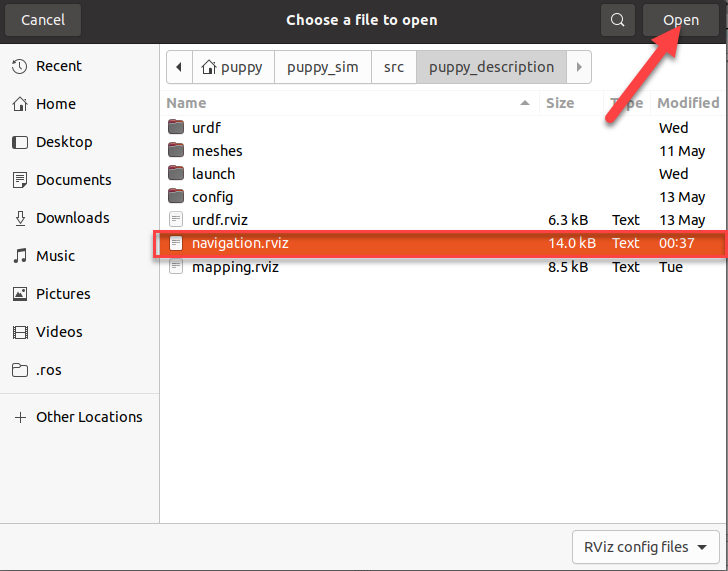
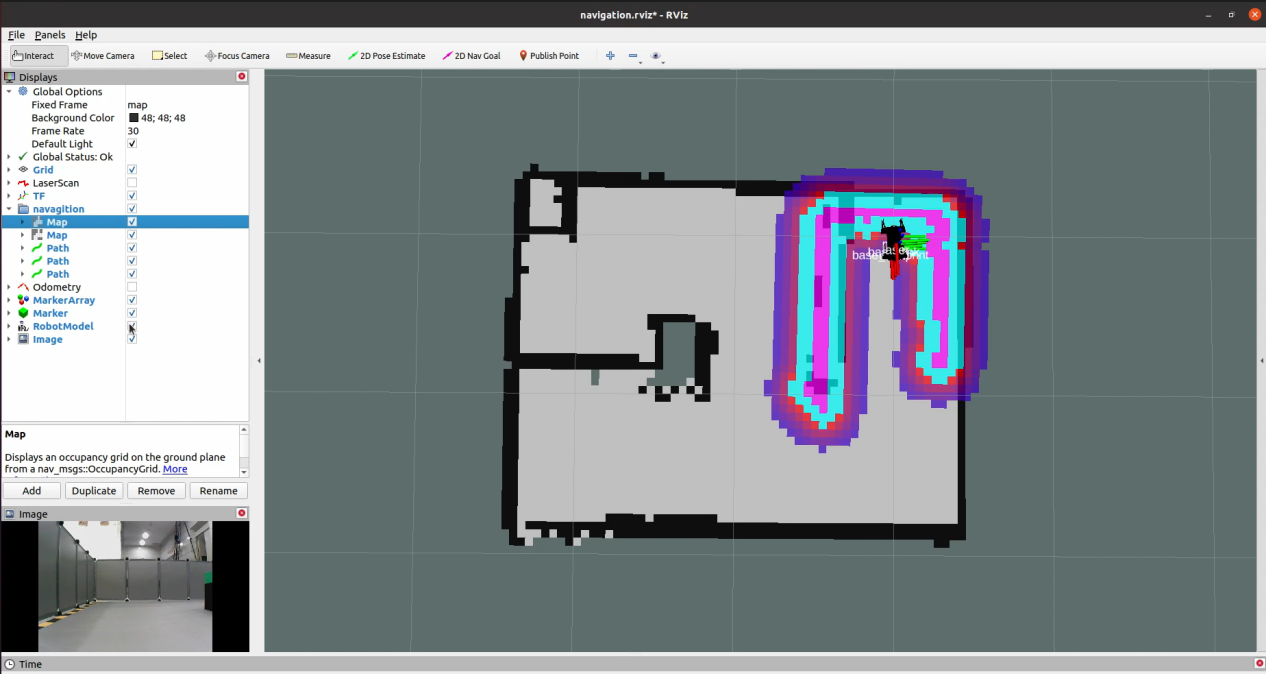
17.10.4 Program Outcome
Grasp Color Block
Before starting the navigation, we need to have Puppypi grasp the color block. Here, we need to use the upper computer to control the opening of the mechanical arm gripper and place the color block inside the gripper.
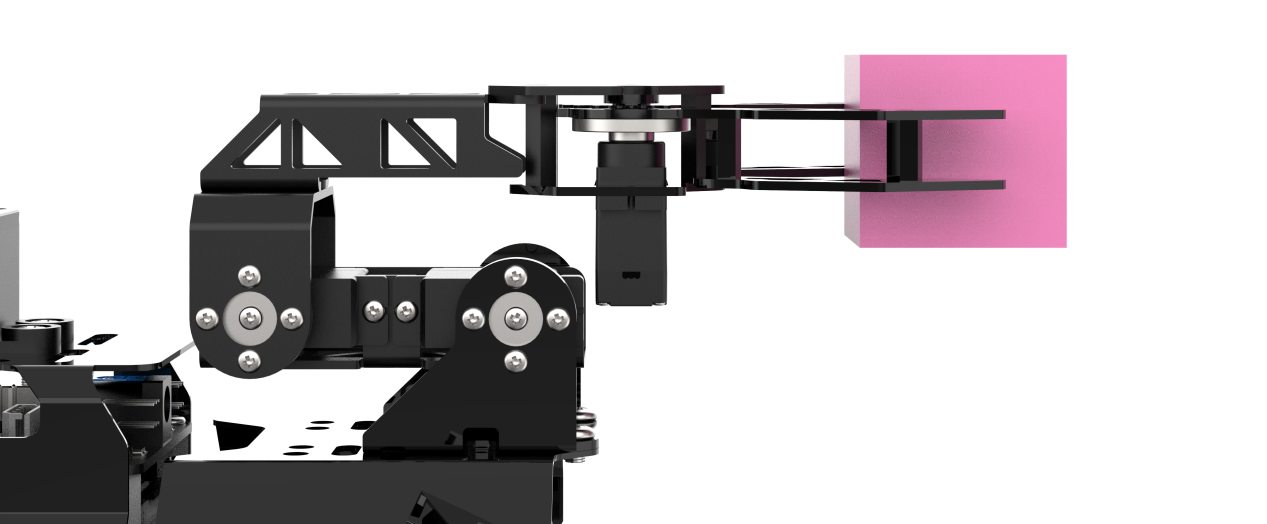
Start Navigation
Based on the content in the red box in the following image, issue commands to the robot dog. When navigating, we need to use the first tool to set the initial position of the robot dog, and the second tool to set the target point. The robot dog will automatically set the route according to the map, avoid obstacles, and reach the target point.
Note
If you need to interrupt navigation, simply set a new target point using the second tool at the current location of the robot dog. If you pick up the robot dog or its position is altered by external force, you will need to reset its position manually.
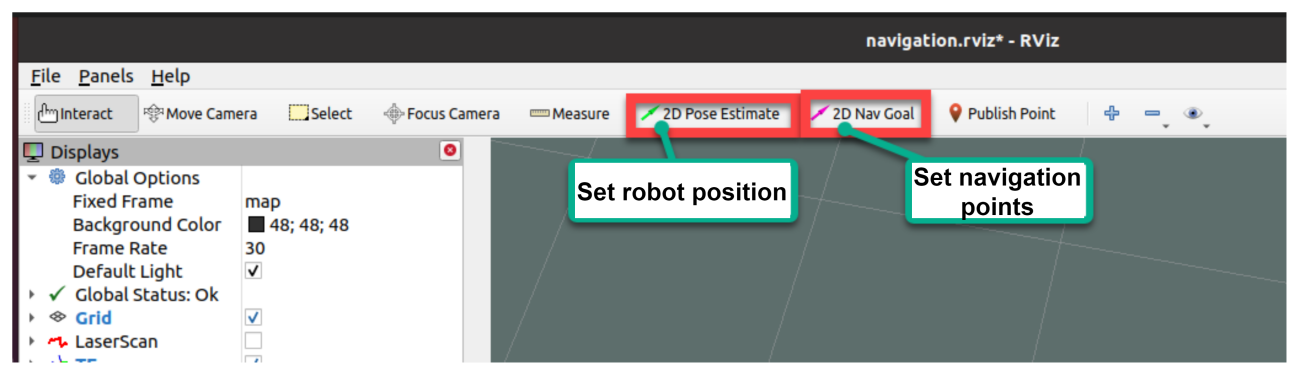
After setting the target point, two lines will be generated: one green and one red. The green line represents the global route that the robot dog will take to reach the target, while the red line represents the local route planned by the robot dog.
Begin Placing the Color Blocks
After reaching the navigation point, the robot dog enters the next state and begins to search for the red box. Once the red box is found, it executes action group control to move the mechanical arm and place the color block into the red box.
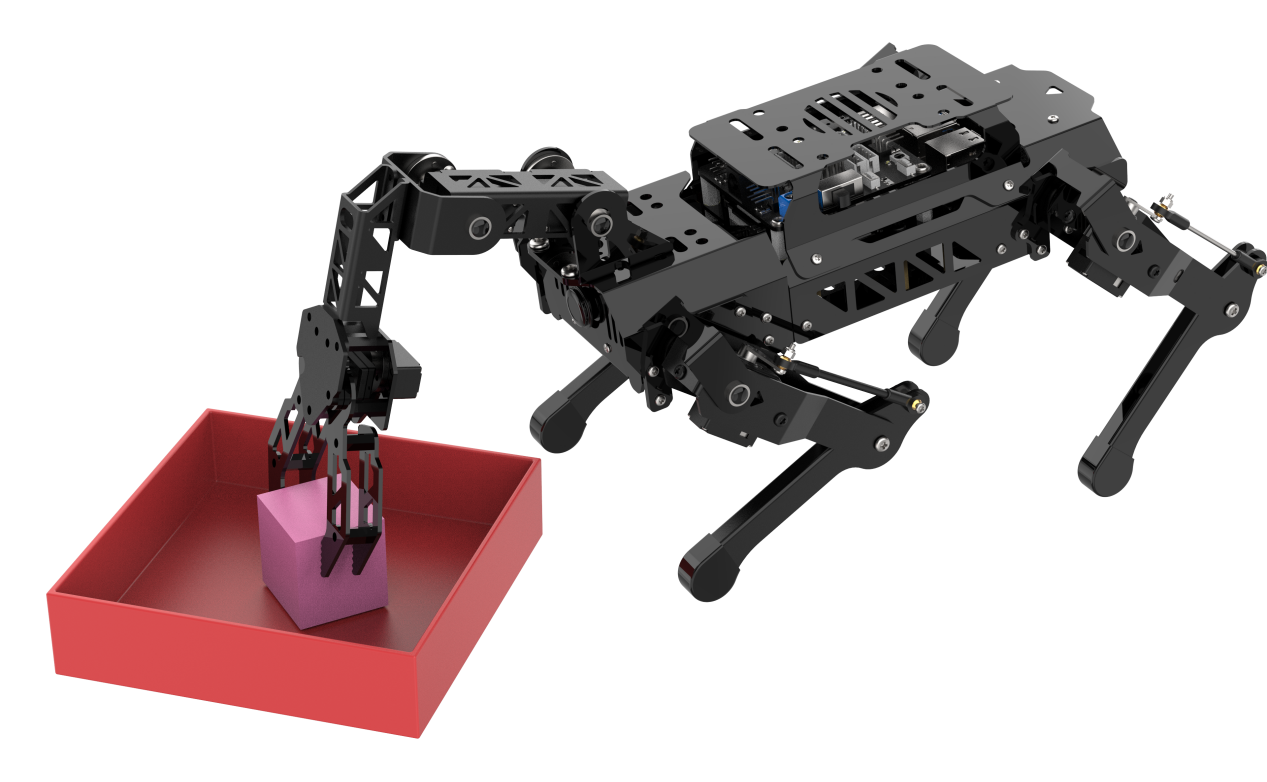
17.10.5 Program Analysis
Launch File Analysis
(1) Basic configuration files for robot navigation and transportation are located in the Docker container. The source code for this program is also within the Docker container:
/home/ubuntu/puppypi/src/puppy_bringup/launch/start_node_nav.launch
<launch>

    <!--lab参数加载(Lab parameter loading)-->
    <include file="$(find lab_config)/launch/lab_config_manager.launch" />

    <include file="$(find puppy_pi_bringup)/launch/start_camera.launch" />

    <include file="$(find ldlidar)/launch/LD06.launch" />
    <include file="$(find puppy_navigation)/launch/include/lidar_filter.launch"/>
    <include file="$(find puppy_pi_bringup)/launch/start_puppy_control.launch"/>

</launch>
lab_config_manager.launch: This file contains the relevant information for lab parameter configuration.
start_camera.launch: This file contains the configuration for starting the camera.
LD06.launch: This file contains the configuration for starting the LD06 laser radar.
lidar_filter.launch: This file contains the configuration for laser radar data filtering.
start_puppy_control.launch: This file contains the configuration for starting the robot dog control node.
(2) Robot dog navigation files. The source code for this program is also within the Docker container:
/home/ubuntu/puppypi/src/puppy_navigation/launch/navigation.launch
6 7 8 9 10 | <include file="$(find puppy_slam)/launch/include/rf2o_laser_odometry.launch" /> <node pkg="tf" type="static_transform_publisher" name="base_footprint_to_imu" args="0 0 0.125 0 0 0 base_footprint imu_link 20"/> <include file="$(find puppy_slam)/launch/include/ekf_template.launch" /> |
Launch the nodes for the odometry, coordinate transformation, and extended Kalman filter for the laser radar:
rf2o_laser_odometry.launch: This file contains the relevant configuration for the RF2O laser odometry.
A static_transform_publisher node from the tf package is launched to publish a static coordinate transformation from base_footprint to imu_link, with parameters specifying the translation and rotation of the transformation.
ekf_template.launch: This file contains the relevant configuration for the Extended Kalman Filter (EKF).
12 13 14 15 16 17 18 | <!-- 启动Map server功能包,发布地图 --> <arg name="map_file" default="$(find puppy_slam)/maps/map1.yaml"/> <node name="map_server" pkg="map_server" type="map_server" args="$(arg map_file)" /> <arg name="initial_pose_x" default="0.0"/> <arg name="initial_pose_y" default="0.0"/> <arg name="initial_pose_a" default="0.0"/> |
Start the Map Server package, publish the specified map, and set the initial pose of the robot using parameters.
20 21 22 23 24 25 | <!-- 启动AMCL 自适应蒙特卡洛定位算法包 --> <include file="$(find puppy_navigation)/launch/include/amcl.launch"> <arg name="initial_pose_x" value="$(arg initial_pose_x)"/> <arg name="initial_pose_y" value="$(arg initial_pose_y)"/> <arg name="initial_pose_a" value="$(arg initial_pose_a)"/> </include> |
Start the AMCL algorithm package and pass some initial pose parameters to the AMCL algorithm node. This helps with adaptive Monte Carlo localization, enabling precise localization of the robot in the environment.
12 13 14 15 16 17 18 19 20 21 22 23 24 25 26 27 28 29 30 31 32 33 34 35 36 37 38 39 40 | <!-- 启动路径规划算法包 --> <node pkg="move_base" type="move_base" respawn="true" name="move_base_node" output="screen" clear_params="true"> <rosparam file="$(find puppy_navigation)/config/costmap_common_params.yaml" command="load" ns="global_costmap" /> <rosparam file="$(find puppy_navigation)/config/costmap_common_params.yaml" command="load" ns="local_costmap" /> <rosparam file="$(find puppy_navigation)/config/local_costmap_params.yaml" command="load" /> <rosparam file="$(find puppy_navigation)/config/global_costmap_params.yaml" command="load" /> <rosparam file="$(find puppy_navigation)/config/base_global_planner_param.yaml" command="load" /> <rosparam file="$(find puppy_navigation)/config/teb_local_planner_params.yaml" command="load" /> <!-- <rosparam file="$(find rrt_exploration_tutorials)/param/base_local_planner_params.yaml" command="load" /> --> <rosparam file="$(find puppy_navigation)/config/move_base_params.yaml" command="load" /> <param name="global_costmap/global_frame" value="map"/> <param name="global_costmap/robot_base_frame" value="base_footprint"/> <param name="local_costmap/global_frame" value="odom"/> <param name="local_costmap/robot_base_frame" value="base_footprint"/> <!-- move base default publish cmd to /cmd_vel topic,now remap to /robot0/cmd_vel --> <remap from="/cmd_vel" to="/cmd_vel_nav"/> <!-- move_base default subscribe odom topic,now remap to /robot0/odom --> <remap from="/odom" to="/odom"/> <!-- move_base default subscribe map topic,now remap to /amcl/map --> <remap from="/map" to="/map"/> </node> <!-- 多点导航 --> <node pkg="puppy_navigation" type="publish_point.py" name="publish_point" output="screen"/> </launch> |
Configure the ROS Move Base node, including loading different parameter files and performing some remapping operations:
The costmap_common_params.yaml file is used to configure the global and local costmaps.
The local_costmap_params.yaml and global_costmap_params.yaml files are used to configure specific parameters for the local and global costmaps.
The base_global_planner_param.yaml file is used to configure parameters for the global planner.
The teb_local_planner_params.yaml file is used to configure parameters for the local planner.
The move_base_params.yaml file contains additional parameters for the Move Base node.
<param> tags: Set some specific parameters for the Move Base node:
global_costmap/global_frame and local_costmap/global_frame: Set the coordinate frame for the global and local costmaps.
global_costmap/robot_base_frame and local_costmap/robot_base_frame: Set the coordinate frame for the robot base of the global and local costmaps.
<remap> tags: Remap some topics, remapping topics originally published to /cmd_vel, subscribed to /odom, and subscribed to /map to /cmd_vel_nav, /odom, and /map respectively.
(3) RVIZ configuration file for the robot dog virtual machine: /home/puppy_sim/src/puppy_description/launch/rviz_with_urdf.launch
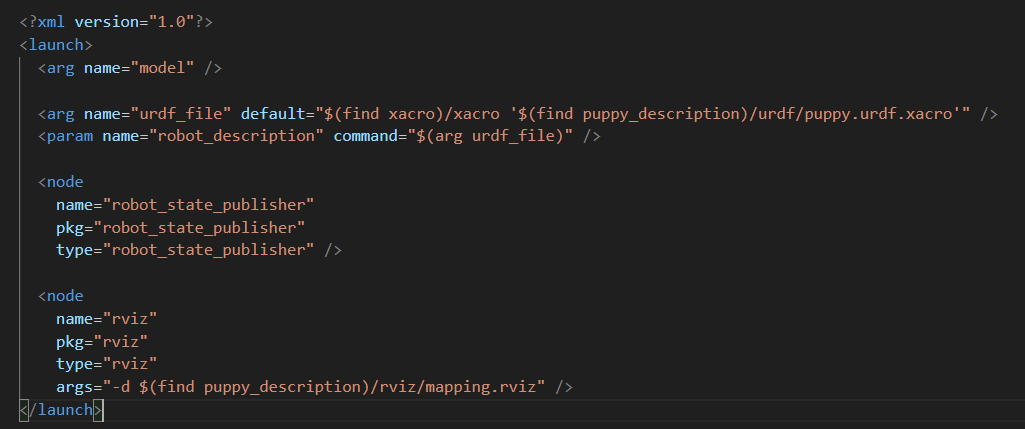
Start the robot’s URDF model and related ROS nodes:
Define a parameter model for passing model information.
Define urdf_file, where the URDF file is compiled into a URDF description file using the xacro tool. The path to the URDF file is $(find puppy_description)/urdf/puppy.urdf.xacro.
The content of the URDF description file is set as the parameter robot_description. This is provided to the robot_state_publisher node to publish the robot’s state.
A robot_state_publisher node is launched to publish the robot’s state information, making it available in the ROS system.
An rviz node is launched for visualizing the robot model. The path to the RViz configuration file is specified with the -d parameter, which is $(find puppy_description)/rviz/mapping.rviz.
Source Code Program Analysis
The source code for this program is located in the Docker container:/home/ubuntu/puppypi/src/puppy_with_arm/scripts/color_place_nav.py
Import Related Application Library
4 5 6 7 8 9 10 11 12 13 14 15 16 17 18 19 20 21 22 | import sys import cv2 import math import time import rospy from enum import Enum import threading import numpy as np from arm_kinematics.ArmMoveIK import ArmIK from common import Misc from common import PID from std_msgs.msg import Header from sensor_msgs.msg import Image from puppy_control.msg import Velocity, Pose, Gait,SetServo from std_srvs.srv import * from actionlib_msgs.msg import GoalStatusArray from puppy_control.srv import SetRunActionName |
① sys is used for handling command-line arguments and exiting the program;
② cv2 is used for OpenCV image processing;
③ math is used for mathematical calculations;
④ time is used for timing and delays;
⑤ enum is used for defining program running state;
⑥ threading is used for implementing parallel processing.
⑦ Import ArmIK from arm_kinematics.ArmMoveIK for inverse kinematics control;
⑧ Import Velocity, Pose, and Gait message types from puppy_control.msg for controlling the velocity, pose, and gait of the robot dog.
⑨ Import ArmIK from arm_kinematics.ArmMoveIK for inverse kinematics control.
25 26 | sys.path.append('/home/ubuntu/software/puppypi_control/') from servo_controller import setServoPulse |
A variable named HomePath is defined, representing the home directory path as /home/pi. Then, /home/pi/PuppyPi_PC_Software is added to the Python module search path using sys.path.append.
The function setServoPulse is imported from the module ServoCmd. This indicates that the ServoCmd module contains a function named setServoPulse, which is used to control the pulse signal of servo motors.
Main Function
188 189 190 191 192 193 194 195 196 197 198 199 200 201 202 203 204 205 206 207 208 209 210 211 212 213 | if __name__ == '__main__': rospy.init_node('navigation_status_listener') color_range_list = rospy.get_param('/lab_config_manager/color_range_list', {}) PuppyGaitConfigPub = rospy.Publisher('/puppy_control/gait', Gait, queue_size=1) PuppyVelocityPub = rospy.Publisher('/puppy_control/velocity', Velocity, queue_size=1) PuppyPosePub = rospy.Publisher('/puppy_control/pose', Pose, queue_size=1) runActionGroup_srv = rospy.ServiceProxy('/puppy_control/runActionGroup', SetRunActionName) rospy.Subscriber('/move_base/status', GoalStatusArray, goal_status_callback) rospy.Subscriber('/usb_cam/image_raw', Image, image_callback) result_publisher = rospy.Publisher('~image_result', Image, queue_size=1) # 图像处理结果发布,# 使用~可以自动加上前缀名称(image processing result published. use "~" to automatically add the prefix name) time.sleep(0.3) PuppyPose = Stand.copy() PuppyPosePub.publish(stance_x=PuppyPose['stance_x'], stance_y=PuppyPose['stance_y'], x_shift=PuppyPose['x_shift'] ,height=PuppyPose['height'], roll=PuppyPose['roll'], pitch=PuppyPose['pitch'], yaw=PuppyPose['yaw'], run_time = 500) time.sleep(0.5) AK.setPitchRangeMoving((8.51,0,3.3),500) time.sleep(0.5) Debug = False if Debug: time.sleep(0.5) th.start() th1.start() rospy.spin() |
In the main program, initialize the ROS node, set up ROS topic publishers and subscribers, and perform some initialization actions.
- Create ROS topic publishers: used to control the robot dog’s gait, velocity, and pose.
- Create ROS topic subscribers: used to obtain the status of navigation targets and image data, set the initial pose of the robot dog, and publish it.
- If the debug mode is enabled, start two threads, th and th1.
State Call Back Function goal_status_callback
176 177 178 179 180 181 182 183 184 185 186 | def goal_status_callback(msg): global nav_status if len(msg.status_list) > 0: status = msg.status_list[0].status if status == 3: # 3表示目标已经到达(3 means the target has arrived) if not nav_status: rospy.loginfo("target") th.start() th1.start() nav_status = True |
Listen to the /move_base/status topic. When the received target status is 3 (target has been reached), output information through ROS logging, and start two threads named th and th1. At the same time, set the global variable nav_status to True to indicate that the target has been reached.
Function image_callback
171 172 173 174 | def image_callback(ros_image): global image image = np.ndarray(shape=(ros_image.height, ros_image.width, 3), dtype=np.uint8, buffer=ros_image.data) # 原始 RGB 画面(original RGB image) |
Convert the ROS image message ros_image data to a NumPy array for later use in image processing.
Run Image Processing Function
130 131 132 133 134 135 136 137 138 139 140 141 142 143 144 145 146 147 148 149 150 151 152 153 154 155 156 157 158 159 160 161 162 163 164 165 166 167 168 169 | def run(): global image global block_center_point while not rospy.is_shutdown(): if image is not None: img_copy = image.copy() img_h, img_w = image.shape[:2] frame_resize = cv2.resize(img_copy, size, interpolation=cv2.INTER_NEAREST) frame_gb = cv2.GaussianBlur(frame_resize, (3, 3), 3) bgr_image = cv2.cvtColor(frame_gb, cv2.COLOR_RGB2BGR) frame_lab_all = cv2.cvtColor(bgr_image, cv2.COLOR_BGR2LAB) # 将图像转换到LAB空间(convert the image to LAB space) max_area = 0 areaMaxContour_max = 0 frame_mask = cv2.inRange(frame_lab_all, (color_range_list[target_color]['min'][0], color_range_list[target_color]['min'][1], color_range_list[target_color]['min'][2]), (color_range_list[target_color]['max'][0], color_range_list[target_color]['max'][1], color_range_list[target_color]['max'][2])) #对原图像和掩模进行位运算(perform bitwise operation to original image and mask) eroded = cv2.erode(frame_mask, cv2.getStructuringElement(cv2.MORPH_RECT, (3, 3))) #腐蚀(corrosion) dilated = cv2.dilate(eroded, cv2.getStructuringElement(cv2.MORPH_RECT, (3, 3))) #膨胀(dilation) contours = cv2.findContours(dilated, cv2.RETR_EXTERNAL, cv2.CHAIN_APPROX_NONE)[-2] #找出轮廓(find out contour) areaMaxContour, area_max = getAreaMaxContour(contours) #找出最大轮廓(find out the contour with the maximal area) if areaMaxContour is not None: if area_max > max_area:#找最大面积(find the maximal area) max_area = area_max areaMaxContour_max = areaMaxContour if max_area > 200: ((centerX, centerY), radius) = cv2.minEnclosingCircle(areaMaxContour_max) # 获取最小外接圆(obtain minimum circumcircle) centerX = int(Misc.map(centerX, 0, size[0], 0, img_w)) centerY = int(Misc.map(centerY, 0, size[1], 0, img_h)) radius = int(Misc.map(radius, 0, size[0], 0, img_w)) block_center_point = (centerX,centerY) #print(block_center_point) cv2.circle(bgr_image, (centerX, centerY), radius, (0,255,255), 2)#画圆(draw circle) result_publisher.publish(cv2_image2ros(cv2.resize(bgr_image, (640, 480)), 'navigation_status_listener')) th = threading.Thread(target=run,daemon=True) |
First, preprocess the image, including resizing and Gaussian blurring. Then, identify lines in different regions of interest (ROIs) based on predefined color ranges, calculate the center point positions of the line contours, calculate the parameters of the minimum enclosing circle for the largest area color block, output different recognition results based on judgment, and display the recognition results in the image. The overall logic is to control the motion of the robot dog by identifying colors, extracting contours, finding the largest area, and outputting recognition results based on the image.
(1) Preprocess the image, including resizing and Gaussian blurring.
138 139 | frame_resize = cv2.resize(img_copy, size, interpolation=cv2.INTER_NEAREST) frame_gb = cv2.GaussianBlur(frame_resize, (3, 3), 3) |
(2) Convert the image from BGR to LAB format, then segment the preprocessed image into three regions: upper, middle, and lower. Convert the RGB color of the image blocks in the three regions to LAB color space, and then perform bitwise operations with the mask.
130 131 132 133 134 135 136 137 138 139 | frame_lab_all = cv2.cvtColor(bgr_image, cv2.COLOR_BGR2LAB) # 将图像转换到LAB空间(convert the image to LAB space) max_area = 0 areaMaxContour_max = 0 frame_mask = cv2.inRange(frame_lab_all, (color_range_list[target_color]['min'][0], color_range_list[target_color]['min'][1], color_range_list[target_color]['min'][2]), (color_range_list[target_color]['max'][0], color_range_list[target_color]['max'][1], color_range_list[target_color]['max'][2])) #对原图像和掩模进行位运算(perform bitwise operation to original image and mask) |
(3) After masking, perform erosion and dilation operations on the image. Extract the outer contours of the target using the cv2.findContours() function, and call the getAreaMaxContour() function to detect contours and find the largest contour.
151 152 153 154 | eroded = cv2.erode(frame_mask, cv2.getStructuringElement(cv2.MORPH_RECT, (3, 3))) #腐蚀(corrosion) dilated = cv2.dilate(eroded, cv2.getStructuringElement(cv2.MORPH_RECT, (3, 3))) #膨胀(dilation) contours = cv2.findContours(dilated, cv2.RETR_EXTERNAL, cv2.CHAIN_APPROX_NONE)[-2] #找出轮廓(find out contour) areaMaxContour, area_max = getAreaMaxContour(contours) #找出最大轮廓(find out the contour with the maximal area) |
(4) Find the contours of color blocks in the image. Filter out contours with an area less than 200 for higher recognition accuracy. Finally, use the cv2.circle() function to draw the minimum enclosing circle on the image with a yellow color.
155 156 157 158 159 160 161 162 163 164 165 166 167 168 169 | if areaMaxContour is not None: if area_max > max_area:#找最大面积(find the maximal area) max_area = area_max areaMaxContour_max = areaMaxContour if max_area > 200: ((centerX, centerY), radius) = cv2.minEnclosingCircle(areaMaxContour_max) # 获取最小外接圆(obtain minimum circumcircle) centerX = int(Misc.map(centerX, 0, size[0], 0, img_w)) centerY = int(Misc.map(centerY, 0, size[1], 0, img_h)) radius = int(Misc.map(radius, 0, size[0], 0, img_w)) block_center_point = (centerX,centerY) #print(block_center_point) cv2.circle(bgr_image, (centerX, centerY), radius, (0,255,255), 2)#画圆(draw circle) result_publisher.publish(cv2_image2ros(cv2.resize(bgr_image, (640, 480)), 'navigation_status_listener')) th = threading.Thread(target=run,daemon=True) |
Move Perform Action Function
85 86 87 88 89 90 91 92 93 94 95 96 97 98 99 100 101 102 103 104 105 106 107 108 109 110 111 112 113 114 115 116 117 118 119 120 121 122 123 124 125 126 127 128 | def move(): global block_center_point global PuppyPose,PuppyPosePub global puppyStatus while not rospy.is_shutdown(): if puppyStatus == PuppyStatus.START: PuppyPose = Bend.copy() PuppyPosePub.publish(stance_x=PuppyPose['stance_x'], stance_y=PuppyPose['stance_y'], x_shift=PuppyPose['x_shift'] ,height=PuppyPose['height'], roll=PuppyPose['roll'], pitch=PuppyPose['pitch'], yaw=PuppyPose['yaw'], run_time = 500) PuppyGaitConfigPub.publish(overlap_time = GaitConfig['overlap_time'], swing_time = GaitConfig['swing_time'] , clearance_time = GaitConfig['clearance_time'], z_clearance = GaitConfig['z_clearance']) time.sleep(1) puppyStatus = PuppyStatus.NORMAL elif puppyStatus == PuppyStatus.NORMAL: if block_center_point[1] > 270 and abs(block_center_point[0] - img_centerx) < 70: # 已经发现目标物块,只有物块在线上才满足(target object detected; it is considered valid only if the object is on the line) rospy.ServiceProxy('/puppy_control/go_home', Empty)() time.sleep(0.1) runActionGroup_srv('place.d6a',True) # 执行动作组(perform action group) puppyStatus = PuppyStatus.STOP else: value = block_center_point[0] - img_centerx if block_center_point[1] <= 250: PuppyMove['x'] = 10 PuppyMove['yaw_rate'] = math.radians(0) elif abs(value) > 80: PuppyMove['x'] = 5 PuppyMove['yaw_rate'] = math.radians(-11 * np.sign(value)) elif abs(value) > 50: PuppyMove['x'] = 5 PuppyMove['yaw_rate'] = math.radians(-5 * np.sign(value)) elif block_center_point[1] <= 270: PuppyMove['x'] = 8 PuppyMove['yaw_rate'] = math.radians(0) PuppyVelocityPub.publish(x=PuppyMove['x'], y=PuppyMove['y'], yaw_rate=PuppyMove['yaw_rate']) elif puppyStatus == PuppyStatus.STOP: AK.setPitchRangeMoving((8.51,0,3.3),500) time.sleep(0.5) PuppyPose = Stand.copy() PuppyPosePub.publish(stance_x=PuppyPose['stance_x'], stance_y=PuppyPose['stance_y'], x_shift=PuppyPose['x_shift'] ,height=PuppyPose['height'], roll=PuppyPose['roll'], pitch=PuppyPose['pitch'], yaw=PuppyPose['yaw'], run_time = 500) time.sleep(0.5) th1 = threading.Thread(target=move,daemon=True) |
During the startup phase (PuppyStatus.START), the robot dog stops moving and initializes its posture. During normal forward movement (PuppyStatus.NORMAL), it moves control based on the position information of the target block. If the target block is found within the specified area, it executes the place.d6a action group to place the block at the target point and switches to the PuppyStatus.STOP status. Otherwise, it adjusts the robot dog’s movement speed and angular velocity based on the position of the target block. If puppyStatus is PuppyStatus.STOP, the robot dog’s posture is switched to the standing posture (Stand), and the corresponding posture information is published.
getAreaMaxContour Function
42 43 44 45 46 47 48 49 50 51 52 53 54 55 56 | # 找出面积最大的轮廓(find out the contour with the maximal area) # 参数为要比较的轮廓的列表(the parameter is the list of contour to be compared) def getAreaMaxContour(contours): contour_area_temp = 0 contour_area_max = 0 area_max_contour = None for c in contours: # 历遍所有轮廓(iterate through all contours) contour_area_temp = math.fabs(cv2.contourArea(c)) # 计算轮廓面积(calculate contour area) if contour_area_temp > contour_area_max: contour_area_max = contour_area_temp if contour_area_temp >= 5: # 只有在面积大于300时,最大面积的轮廓才是有效的,以过滤干扰(only when the area is greater than 300, the contour with the maximal area is valid to filter the interference) area_max_contour = c return area_max_contour, contour_area_max # 返回最大的轮廓(return the contour with the maximal area) |
To find the contour with the largest area from a group of contours, the function iterates through all contours, calculates their areas, and retains the contour with the largest area. It also adds a condition to only consider contours with an area greater than or equal to 5 to filter out smaller disturbances. Finally, the function returns the found largest contour along with its corresponding area.
cv2_image2ros Image Information Processing
28 29 30 31 32 33 34 35 36 37 38 39 40 | def cv2_image2ros(image, frame_id=''): image = image[:,:,::-1] ros_image = Image() header = Header(stamp=rospy.Time.now()) header.frame_id = frame_id ros_image.height = image.shape[:2][0] ros_image.width = image.shape[:2][1] ros_image.encoding = 'rgb8' ros_image.data = image.tostring() ros_image.header = header ros_image.step = ros_image.width * 3 return ros_image |
The function converts OpenCV format image data to a ROS Image message (sensor_msgs/Image). It reverses the channel colors of the image and then creates and sets the relevant attributes of the ROS Image message, including height, width, encoding format, etc. Finally, it returns the created ROS Image message. This function is useful for processing OpenCV image data in ROS and publishing it as ROS Image messages.
17.10.6 Function Extension
The default game recognizes red color, and the robot dog performs grab and place actions for the color blocks. If you need to change the recognized color, for example, to green color blocks, you can follow the steps below:
(1) Enter the following command to edit the color recognition and grabbing game program, and press Enter.
rosed puppy_with_arm color_grab.py
(2) Find the following code:

Note
After entering the code position number on the keyboard, press Shift+G to directly jump to the corresponding position. (The numbering of code positions in the diagram is for reference only, please refer to the actual positions.)
(3) Press the i key to enter edit mode, and change red to green.
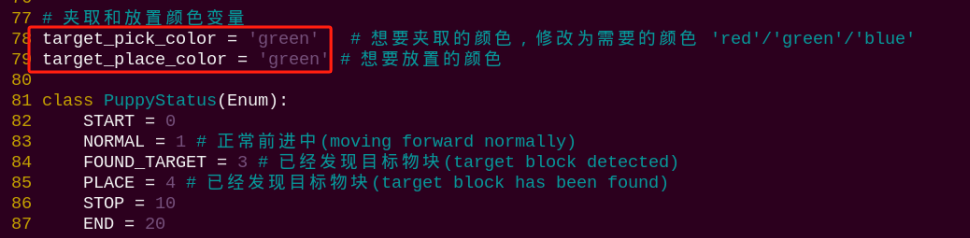
(4) After making the modifications, press the Esc key, enter the command :wq, and press Enter to save and exit.
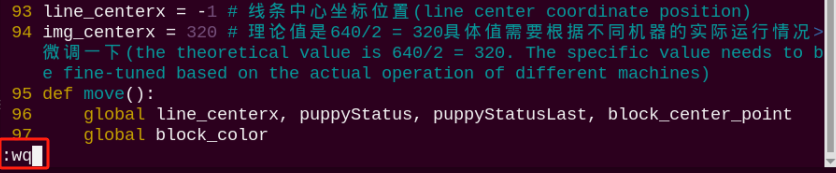
(5) Refer to 17.10.3 Start Navigation to restart the game and view the effects of the modification.
17.11 Inverse Kinematics Analysis of Robotic Arm
17.11.1 Inverse Kinematics Introduction
Brief Introduction of Inverse Kinematics
Inverse kinematics is the process of determining the parameters of the joint movable object to be set to achieve the required posture.
The inverse kinematics of the robotic arm is an important foundation for its trajectory planning and control. Whether the inverse kinematics solution is fast and accurate will directly affect the accuracy of the robotic arm’s trajectory planning and control. so it is important to design a fast and accurate inverse kinematics solution method for a six-degree-of-freedom robotic arm.
Brief Analysis of Inverse Kinematics
For the robotic arm, the position and orientation of the gripper are given to obtain the rotation angle of each joint. The three-dimensional motion of the robotic arm is complicated. In order to simplify the model, we remove the rotation joint of the pan-tilt so that the kinematics analysis can be performed on a two-dimensional plane.
Inverse kinematics analysis generally requires a large number of matrix operations, and the process is complex and computationally expensive, so it is difficult to implement. In order to better meet our needs, we use geometric methods to analyze the robotic arm
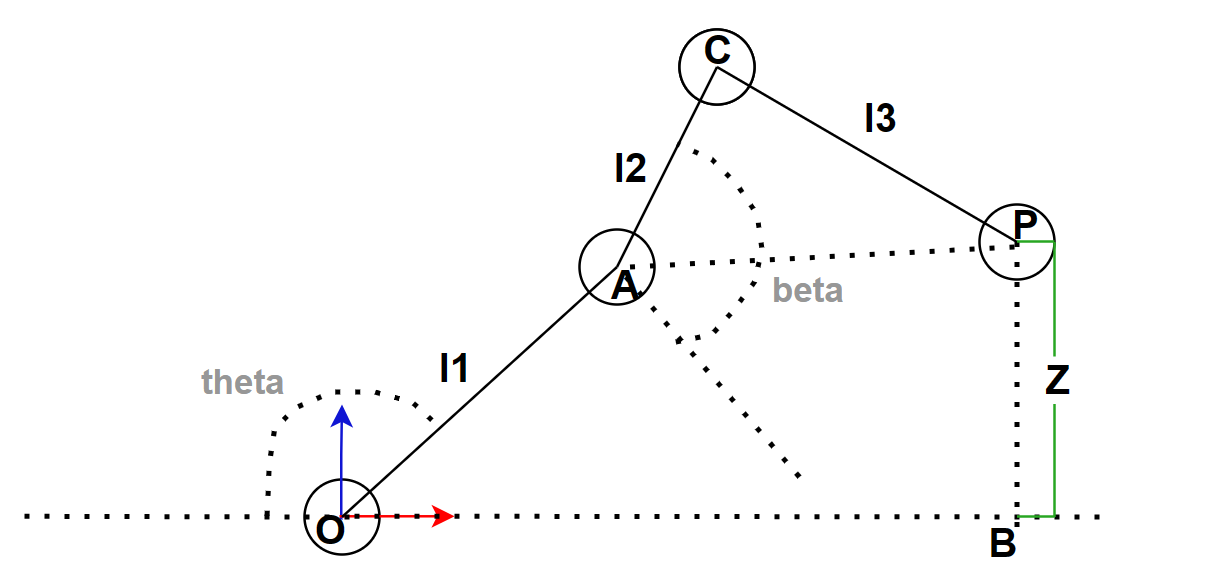
We simplify the model of the robotic arm by removing the XOY plane, leaving us with the main body of the arm. From the diagram, we can see that the coordinates of the end effector P of the gripper are (X, Y, Z). Since the robotic arm has no rotation, the coordinates of P can be written as (X, Z). In this case, theta and beta in the diagram represent the rotation angles of the robotic arm that we need to solve for. Based on this, we can formulate the following equations:
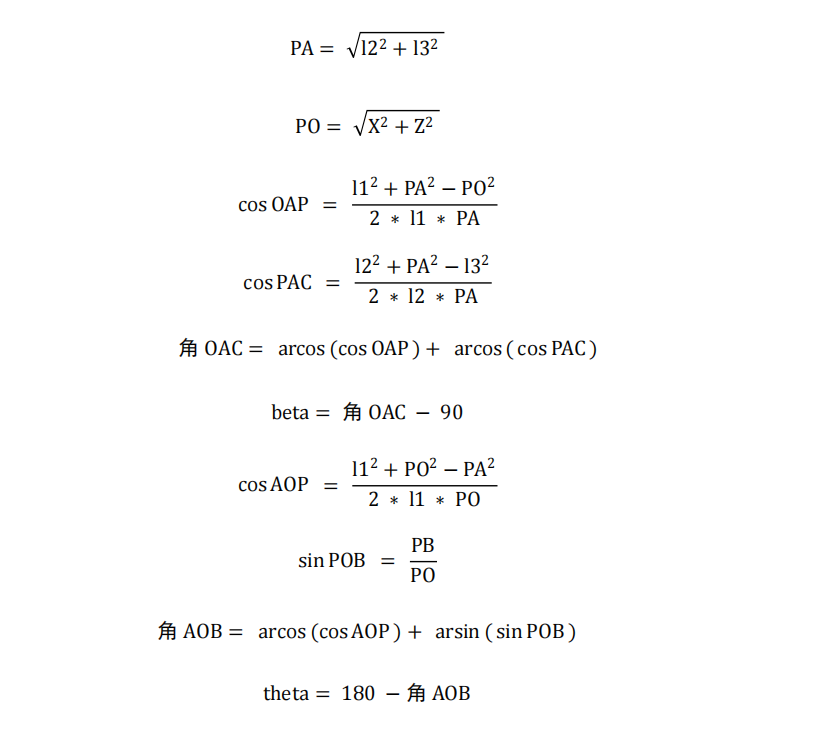
17.11.2 Inverse Kinematics Analysis of Robotic Arm
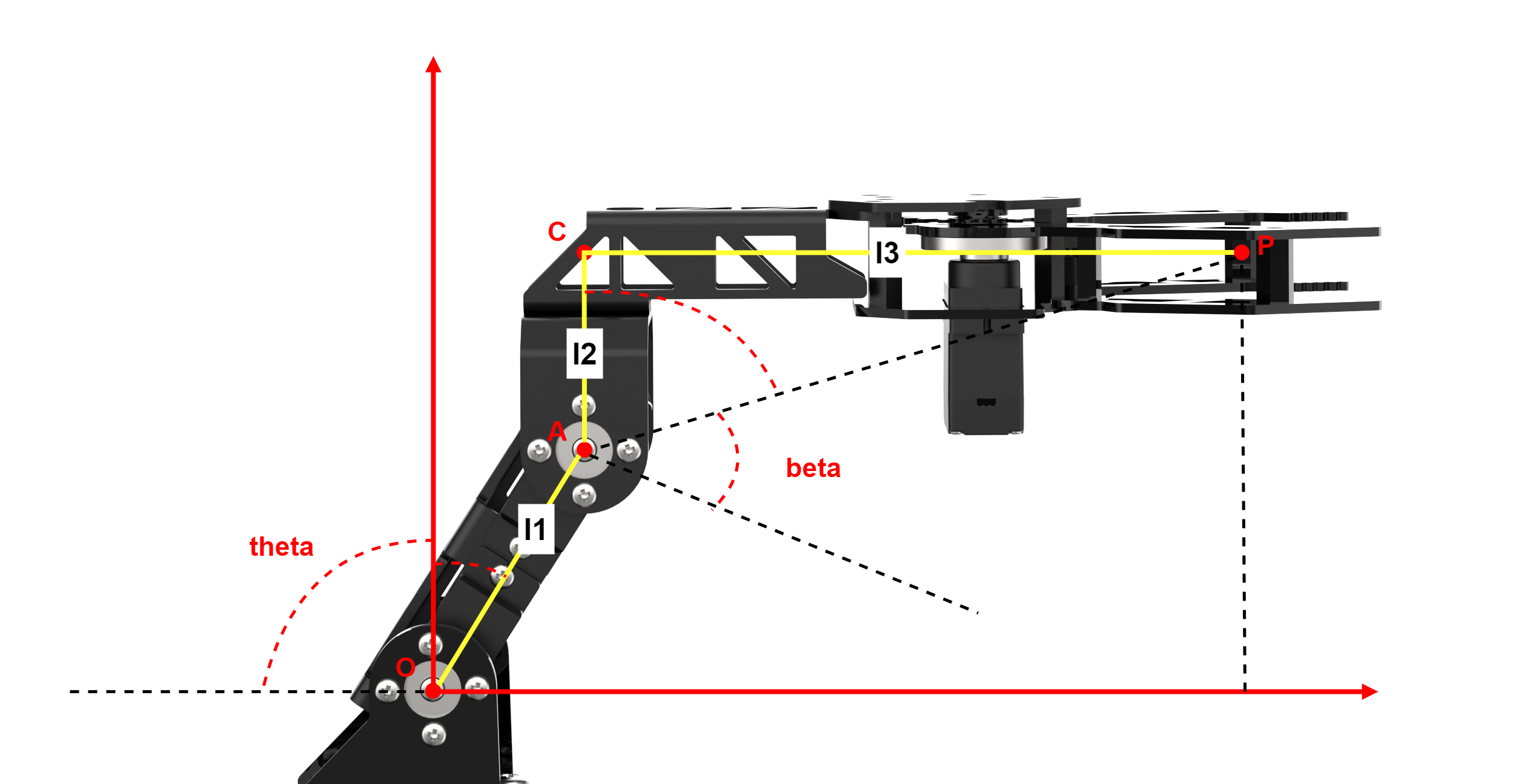
According to the structure design of the robot dog, we can determine that the length of l1 is 4.21 centimeters, the length of l2 is 3.3 centimeters, and the length of l3 is 12.7 centimeters. Therefore, the length of PA is √(l2² + l3²).
The source code of this program is stored at: /home/ubuntu/puppypi/src/puppy_common/kinematics sdk/arm kinematics/InverseKinematics.py
17.11.3 Inverse Kinematics Solution and Program Implementation
Note
Instructions must be entered with strict attention to case sensitivity and spacing.
(1) Turn on PuppyPi, and connect it to Raspberry Pi desktop via VNC.
(2) Click the icon  on the upper left corner to open the Terminator terminal.
(3) Input the following command and press Enter to switch to the directory containing the inverse kinematics program file.
cd puppypi/src/puppy_common/kinematics_sdk/arm_kinematics
(4) Input the command below and press Enter to open the inverse kinematics program file.
vim InverseKinematics.py
(5) Here is a screenshot of the code for the InverseKinematics.py function.
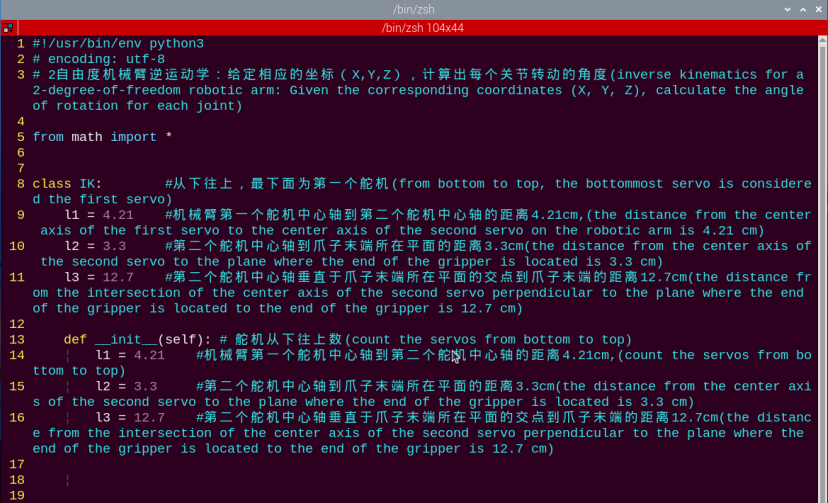
The Calculation of the Pitch Angle beta
(1) According to the cosine theorem, calculate the value, then round it to four decimal places.

(2) Because the range of the cosine value is [-1, 1], check if the absolute value is greater than 1. If it is greater than 1, it means that the given end coordinates cannot form a linkage structure.

(3) Next, calculate the cosPAC value, and then round it to four decimal places.

(4) Check again whether the absolute value exceeds 1.

(5) Next, use the inverse cosine function to find the angle in radians for both OAP and PAC, then add them together to get the angle for OAC.

(6) Finally, convert the angle value of OAC from radians to degrees, and subtract 90 degrees (initial pitch joint angle of the arm) to obtain the pitch joint angle beta rotation.

The Calculation of the Base Joint Angle theta
(1) According to the cosine theorem, calculate the value, then round it to four decimal places.

(2) Because the range of the cosine value is [-1, 1], check if the absolute value of cosAOP is greater than 1. If it is greater than 1, it means that the given end coordinates cannot form a linkage structure.

(3) Then calculate the sinPOB value, round it to four decimal places, and check again whether its absolute value is greater than 1.

(4) Next, use the inverse cosine function and the inverse sine function to find the radians of the angles AOP and POB, then add them together to obtain the value of the angle AOB.

(5) Finally, subtract the angle OAB, converted to degrees, from 180 degrees to obtain the rotation angle of the base joint theta.
